


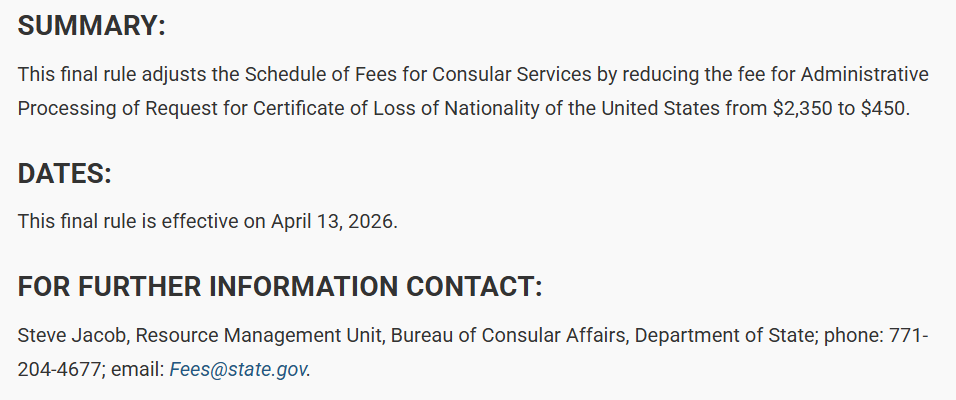
The State Department has reduced the cost of US citizenship renunciation from $2,350 to $450. A final rule published in the Federal Register on March 13, 2026 makes the change effective approximately April 12, 2026.
The fee returns to where it stood between 2010 and 2014, before a surge in renunciation requests led the government to begin charging at full cost. That surge was not coincidental. It tracked the rollout of FATCA, the Foreign Account Tax Compliance Act, which imposed sweeping reporting obligations on foreign financial institutions holding accounts for American clients. Banks responded predictably: by showing their American customers the door.
The $2,350 fee had been the highest expatriation charge of any country in the world. Only the United States and Eritrea tax on the basis of citizenship rather than residency, and only the United States charged over two thousand dollars for the privilege of opting out.
What the Rule Actually Says
The fee reduction came after the State Department received 910 public comments in response to a proposed rule published in October 2023. The overwhelming majority of those comments had less to say about the fee itself than about the broader architecture of American extraterritorial taxation. Commenters described spending hundreds or thousands of dollars each year on tax professionals for returns that generated no U.S. tax liability. They reported being turned away from mortgages, mutual funds, and basic bank accounts in their countries of residence. Several noted they could not even invest in the United States from abroad due to the absence of a U.S. address or phone number.
The State Department was candid about the limits of what it could fix. It cannot rewrite U.S. tax law, eliminate FATCA, or waive the FBAR reporting requirements that parallel FATCA’s burdens. What it could do, and did, was lower this one fee. The $450 figure was chosen because it worked previously without generating complaints and because, adjusted for inflation, it represents less of a financial burden today than it did fifteen years ago.
The Department acknowledged the pressure. Groups including L’Association des Americains Accidentels ,Stop Extraterritorial American Taxation (SEAT), and Democrats Abroad organized many of the public comments and have pursued litigation in federal court. The fee reduction followed a lawsuit filed by the AAA in December 2020 challenging the $2,350 fee as unconstitutional. That case, which remains pending at the D.C. Circuit, prompted the State Department to announce its intent to lower the fee in January 2023, though finalization took more than three years.
Democrats Abroad framed the significance of the rule in terms that went beyond the fee itself. In the government’s own words, the Department took into account what it called “not insignificant anecdotal evidence” of the tax-related difficulties faced by Americans abroad, including in part because of FATCA. The rule further acknowledges that most commenters did not want to give up their citizenship at all. They wanted to remain American but found that worldwide taxation, compliance costs, and financial barriers abroad had made that status increasingly unworkable.
What Was Rejected
Not everyone was satisfied. A group of 215 commenters argued the fee should be closer to $63, based on figures from a State Department Paperwork Reduction Act submission. The Department rejected that calculation, explaining that $63 captured only the time required to read a revised questionnaire, not the full multi-step process that CLN services require: two consular interviews, a review by the Office of American Citizen Services in Washington, and coordination with multiple federal agencies. The real cost to the government of processing a single renunciation is substantially higher than $450, which is why the fee was $2,350 to begin with.
A total of 226 commenters argued that so-called accidental Americans, people born in the United States who have lived abroad their entire lives and have no meaningful connection to the country, should pay nothing at all. The Department declined, noting that administrative costs do not vary based on the applicant’s biography. A handful of others asked for the fee to be means-tested, with waivers for those who could not afford it. That was also rejected on the grounds that it would require burdensome procedures to evaluate each individual’s financial circumstances.
Eight commenters who had already paid $2,350 asked for a refund of the $1,900 difference. They will not get one. The Department’s position is that the higher fee accurately reflected the cost of the service when it was charged, and that the lower fee is a policy choice going forward rather than a correction of an error. Under 22 C.F.R. 22.6, refunds of consular fees are only available when a collection was erroneous under applicable law. This one was not.
The in-person requirement also survives. Commenters pushed for videoconference renunciations to spare applicants the cost of traveling to a U.S. embassy or consulate. The Department acknowledged it continues to study remote options but concluded that CLN services require a consular officer to assess, face to face, whether the individual is acting voluntarily and with genuine intent. The legal basis is INA section 104(a), upheld in Farrell v. Blinken before the D.C. Circuit in 2021.
The Broader Context
The renunciation fee has always been a proxy for larger grievances that the State Department has no authority to address. The United States remains one of two countries in the world that taxes its citizens on worldwide income regardless of where they live. For Americans abroad, this creates a compliance apparatus that includes annual tax returns, FBAR filings, FATCA reporting, and, for those with certain foreign investments, additional forms for PFICs and GILTI. Many of these filings generate no tax revenue. They exist because the law requires them to exist.
The practical consequences are well documented. A 2019 GAO report on FATCA’s implementation found that the interagency response to the burdens on Americans abroad was insufficient. Foreign banks, faced with the compliance costs of identifying and reporting American account holders, have in many cases opted to simply refuse American clients. A 2014 Democrats Abroad survey estimated that the bank accounts of approximately one million Americans living overseas had been closed because of FATCA. As TIME reported, the problems extend well beyond banking into employment restrictions, investment access, and retirement planning.
The projected annual demand for renunciation services is around 4,600 applications. At the new fee, that produces roughly $2.1 million in annual remittance to Treasury, down from approximately $10.8 million. The difference is the cost of the policy decision, and the government is absorbing it willingly.
Tax advisors and expat services firms are already warning that the lower fee will likely increase demand for renunciation appointments at embassies and consulates that are already backlogged, in some cases by a year or more. For anyone considering renunciation, the fee is now substantially lower, but the queue to use it may be substantially longer.
What This Does Not Change
The deeper concerns, citizenship-based taxation, FATCA’s collateral damage, the absence of congressional representation for Americans abroad, remain entirely unresolved by this rule. The State Department said as much. Democrats Abroad put it plainly: “Reducing the renunciation fee addresses one symptom. It does not solve the underlying problem. Only Congress can do that through residence-based taxation.”
But $1,900 less on the bill for someone who only wanted to stop being American is not nothing. It is the first meaningful concession the federal government has made on this issue since the Obama administration raised the fee in the first place.
The new fee takes effect on or about April 12, 2026.