
How many Americans
live abroad?
No one knows.
Since the November 2024 US election, emigration inquiries have reached the highest sustained levels operators in the field have recorded. The underlying question is older. How many US citizens currently live outside the United States, and where are they? No federal agency is in a position to say.
Free to read · no account required

The United States does not count its citizens abroad.
The most-cited figure, nine million, is not a counted number. The 2024 Federal Voting Assistance Program estimate places it at 3.3 million; other respected estimates run to five million; the Congressional Research Service has declined to commit. The structural reason: the United States does not maintain a federal civil register on the European model, address is captured at the driver’s license rather than at the federal level, and the Census Bureau decided in 1976 to exclude private Americans abroad from the decennial enumeration (overseas federal employees and military are still counted). What remains are voluntary touchpoints (tax filings, passport renewals, absentee ballot requests), each measuring a partial subset, none aggregating to a count.
AER was founded to remediate the absence.
The American Emigration Revue is a research publication on US citizens living abroad. It curates the news, the policy developments, the academic literature, and the primary data on a population the federal apparatus declines to enumerate. The editorial premise is simple: if the American state will not count its emigrants, the only available alternative is to ask the receiving states.
Everything we publish sits on one dataset. This is it.
All 99 countries researched by 26 country specialists reading their own statistical systems in their own languages — assembled into a single dashboard where the figures can be compared, sourced and exported. The articles, the index and the briefs all draw on it. It is open: no account, no paywall.
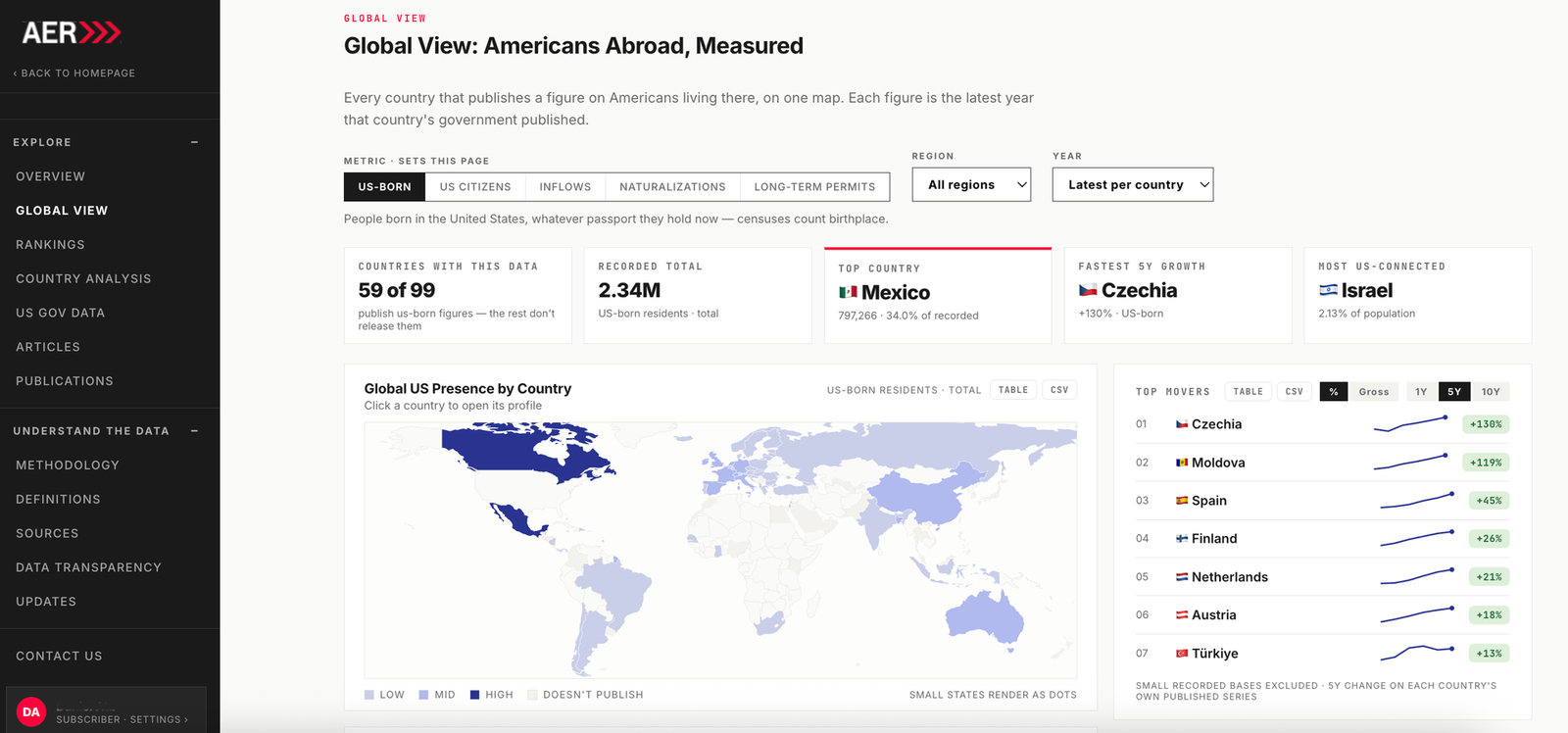
Every country, on one metric, at once.
Switch between US-born stock, US-citizen stock, arrivals, naturalizations and long-term permits. Countries that publish nothing are drawn as gaps rather than guessed at.
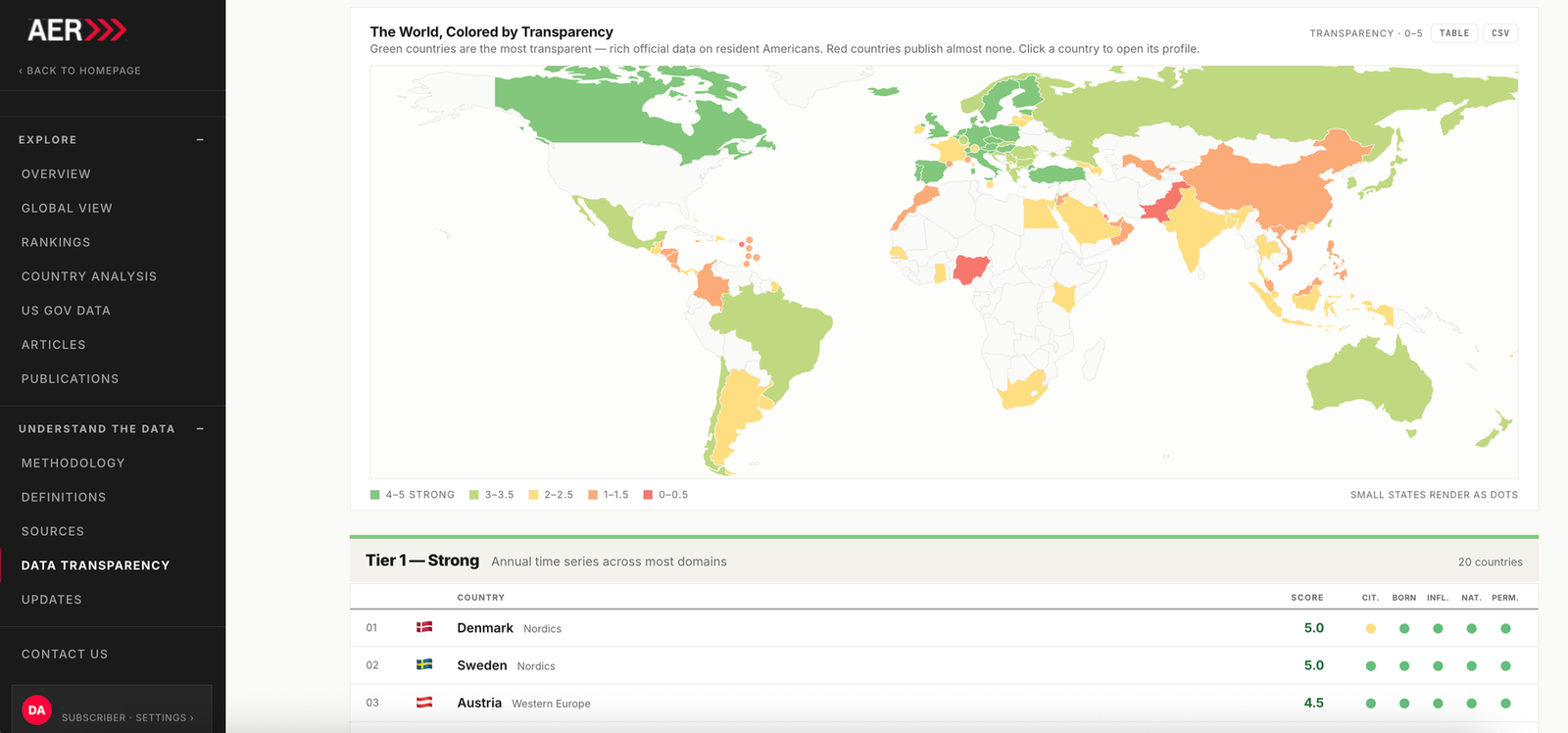
Who publishes, and who does not.
Each country scored across five domains on how completely its public statistics expose data on Americans living there. A low score does not mean few Americans — it means the record cannot tell you.
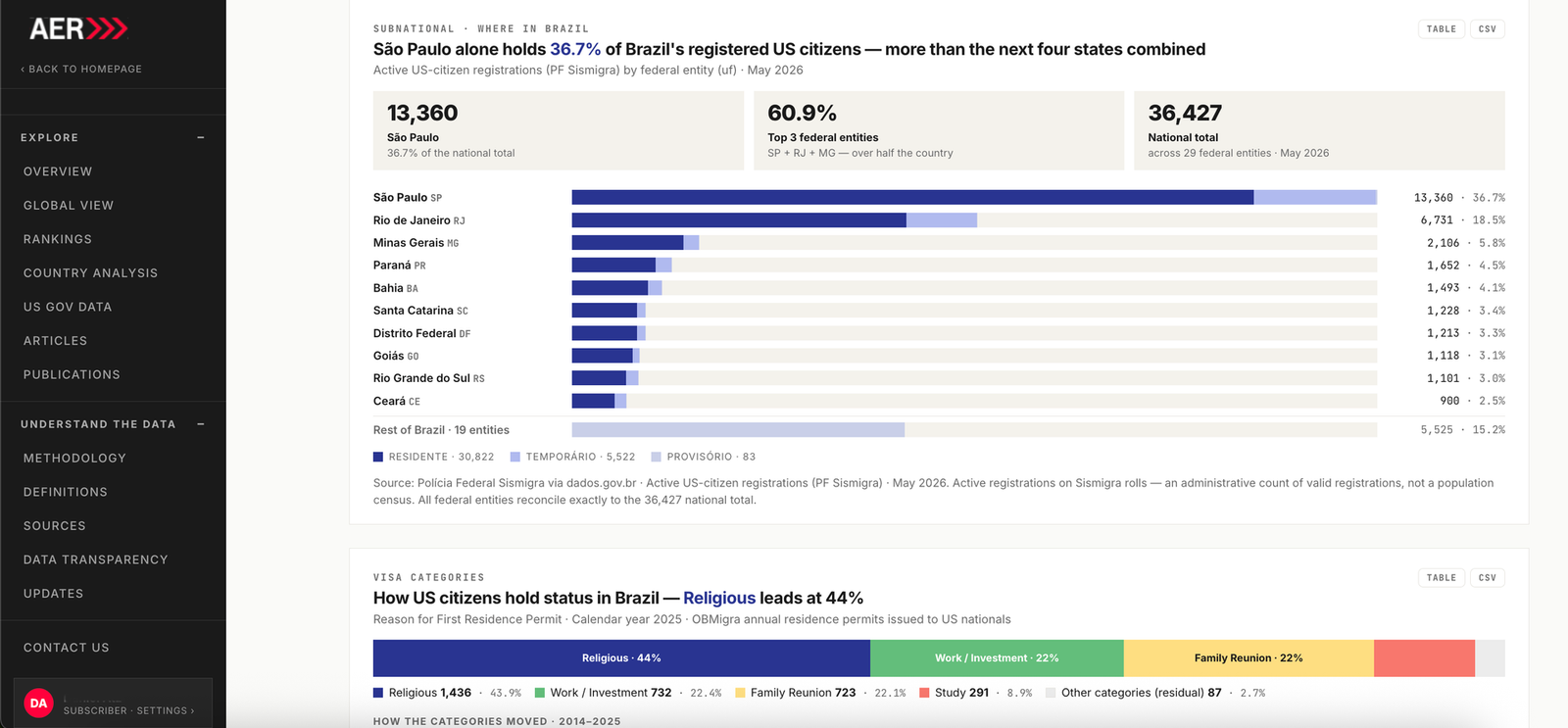
Down to where they actually settle.
Where a government publishes it, the dashboard goes below the national figure — settlement by state or federal unit, age and sex structure, visa-category trends — with the source on every number.
Two minutes inside the dashboard.
Where the figures come from, what each government will and will not release, and how a hole in the public record gets reported as a finding rather than filled with a guess.
A measurement of who publishes, and who does not.
Adjudicated, open to challenge, citable under CC BY 4.0. The clearest published records are below; the full ranked list runs across every country in the dataset, domain by domain.
What the record shows once you read it across borders.

Americans Buy Caribbean Citizenship by Investment and Vanish From the Data
Five CARICOM states operate citizenship-by-investment programs whose grants include free movement across the region. U.S. nationals are plausibly the largest single applicant group, yet they appear in neither set of records: not in destination-country resident tallies, not in U.S. emigration data.

US Emigration to Europe Split 4 Ways in the Eurostat Decade
Eurostat is the only destination-country statistical system that publishes harmonized, country-disaggregated migration data on U.S. nationals. The decade ending in 2025 reveals four overlapping American stories in Europe that pull in different directions.

Gulf States Count Their Americans but Won't Publish the Number
Gulf Cooperation Council states track foreign nationals by nationality for visa management and security purposes but publish almost none of the resulting data. The U.S. resident population across the GCC, plausibly between 50,000 and 80,000 people, represents the clearest example of administrative capacity that does not translate into public disclosure.

Americans Moving to Spain Target Madrid, Barcelona and Valencia
Americans moving to Spain have made it one of the top destinations for U.S. expatriates, with Madrid, Barcelona, and Valencia drawing the biggest share of new arrivals. More than 50,000 U.S. expats are currently living in Spain, a figure that has only continued to rise. In fact, in the last two years, the number of […]
The dashboard is open. Exports, deeper series and institutional access are on request.
Researchers, newsrooms and institutions can request extended access.