

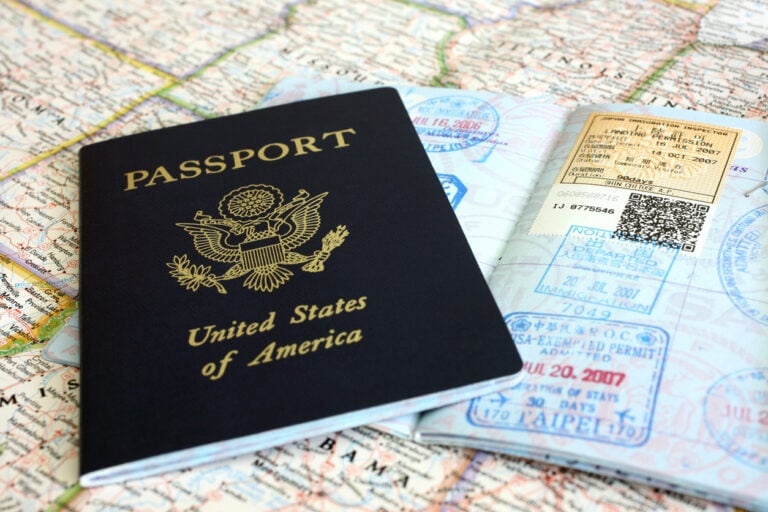

The US passport decline accelerated in 2026, with the Henley Passport Index ranking the United States 10th globally, down six places from 4th in 2006. The Henley Passport Index 2026, compiled from International Air Transport Association data, marks this as the third-largest two-decade decline of any country, behind only Venezuela and Vanuatu. Americans now have visa-free access to 179 destinations, one fewer than in late 2025.
Henley & Partners also reports that Americans are now its largest client market for residence and citizenship-by-investment programs. By the end of Q3 2025, US applications already exceeded the 2024 total by 67%, on top of a 60% year-on-year jump in 2024 itself.
The two trends move together. The passport gets less powerful. Americans buy more options.
What’s driving the US passport decline
The US held first place as recently as 2014, jointly with the UK. Both have fallen sharply since. The US lost seven visa-free destinations over the past year alone, the steepest annual drop on the index.
Specific country-level access changes drove the 2025-2026 decline:
- Brazil ended visa-free entry for US citizens in April 2025 over a lack of reciprocity.
- China expanded its visa-free list rapidly through 2025 while excluding the US, adding 40+ countries over two years.
- Vietnam excluded the US from its latest round of visa-free additions.
- Somalia launched a new eVisa system that ended de facto visa-free entry for Americans.
- Papua New Guinea and Myanmar adjusted access in ways that subtracted from the US score.
Singapore leads the 2026 index with 192 visa-free destinations. Japan and South Korea tie at second with 188. Ten European countries cluster at 4th. The UAE, which added 149 visa-free destinations over 20 years, sits at 5th.
The reciprocity gap
The decline is partly self-inflicted. The US allows only 46 nationalities to enter visa-free, placing it 78th on Henley’s Openness Index, which ranks all 199 countries by inbound visa access. China, by contrast, ranks 62nd on openness, granting visa-free entry to 77 nationalities, 31 more than the US.
Recent US measures have made the gap wider:
- 39 countries face full or partial US entry restrictions as of Jan. 1, 2026.
- ESTA fee nearly doubled from $21 to $40 on Sept. 30, 2025.
- Visa bonds of $5,000 to $15,000 now apply to seven African nations, refundable only on departure.
- A proposed $250 “visa integrity fee” would apply to most non-immigrant visa applications.
- A late-2025 Customs and Border Protection proposal would require Visa Waiver Program travelers from 42 allied countries, including the UK, France, Germany, and Japan, to disclose five years of social media activity, 10 years of email and phone records, and biometric data including facial recognition, fingerprints, and DNA, retained for up to 75 years.
Reciprocity tends to follow. Countries that face heavier US scrutiny on the inbound side typically respond on the outbound side.
How Americans are responding
Henley’s investment migration application volumes give the clearest signal. Through Q3 2025, US application growth ran 67% ahead of 2024’s full-year total, which itself was 60% above 2023. The firm now reports more American clients than its next four nationalities, Turkish, Indian, Chinese, and British, combined.
This tracks patterns visible elsewhere. AE has documented the rise of wealthy Americans pursuing second passports as a hedge on uncertainty and the broader Plan B citizenship market that has scaled rapidly since 2023.
What second passports actually solve
Most Americans pursuing investment migration aren’t leaving the United States. They’re acquiring optionality. A second passport can restore visa-free access lost on the US passport, allow longer stays in the EU under that country’s terms, and provide a fallback under uncertain US policy.
The tradeoffs are real. Most citizenship-by-investment programs require $200,000 to $1 million in qualifying investment or donation. Some carry ongoing tax-residency complications. Holding US citizenship plus another doesn’t eliminate FATCA reporting or US tax-filing obligations.
The Henley data captures intent, not completion. Application volumes are not citizenship grants. The lag between filing and approval runs from months to years.
What this tells us about the US passport decline
The Henley Passport Index measures one thing: how many borders open without a prior visa. That single metric tracks broader currents in US standing, including diplomatic reciprocity, visa-policy posture, and inbound openness. The US has moved in the restrictive direction on all three.
Americans aren’t waiting for the trend to reverse. They’re buying around it. Whether the 2026 application surge translates into completed second citizenships, and whether those citizens stay in the US or eventually relocate, will be visible only in the multi-year data that Henley and national agencies publish separately. The pipeline is now larger than at any prior point in the index’s 20-year history.