



More than 500 Golden Visa investors, predominantly American, are organizing a collective lawsuit against the Portuguese state after Lisbon raised the citizenship timeline from five years to ten years for most non-EU nationals (and to seven years for EU and CPLP nationals). The group is coordinating through WhatsApp and plans to register as a formal association before filing, according to reporting in Expresso.
President António José Seguro promulgated the new Nationality Law (Lei Orgânica nº 1/2026) on May 3, 2026. It was published in the Diário da República on May 18 and entered into force on May 19. The law passed Parliament 152-64 on April 1 after a deal between the governing Social Democratic Party (PSD) and Chega, and it does not extend grandfathering to Golden Visa holders who had residence permits but had not yet filed for nationality before it took effect.
What the New Law Actually Changes
Until May 19, 2026, foreign residents could apply for Portuguese citizenship after five years of legal residence. Lei Orgânica nº 1/2026 restructures that in three ways:
- Most non-EU nationals now wait 10 years before becoming eligible for naturalization, double the previous threshold.
- EU and CPLP nationals wait 7 years, up from 5.
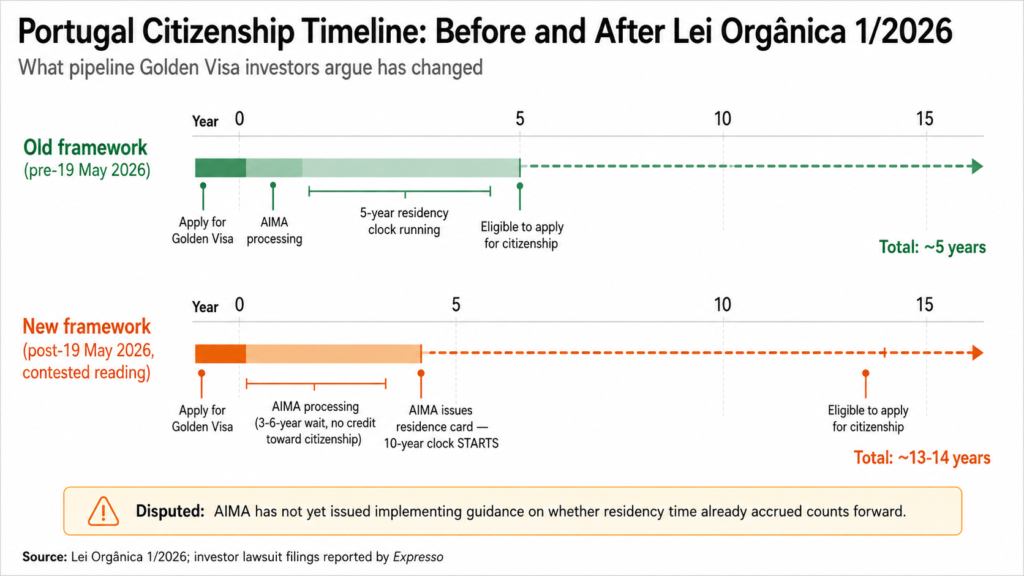
- The residency clock now starts when AIMA issues a residence permit, not when the application is submitted.
The Transitional Rule and What It Leaves Out
Under Article 7.º.2 of the new law, nationality applications already filed on or before May 18, 2026, remain governed by the prior Lei 37/81 regime. There is no equivalent grandfathering provision for foreign residents who held residence permits but had not yet filed for nationality, which is the gap that drives the collective lawsuit.
The new law also survived a Portuguese Constitutional Court review in December 2025 that struck down several other provisions but left the 10-year naturalization timeline intact. Under either the old or the new framework, citizenship was never automatic: foreign residents become eligible to apply for naturalization after the qualifying period, subject to language, integration, and good-conduct requirements.
The Residency Clock Dispute
The new starting-point rule matters more than the headline number suggests. AIMA, Portugal’s migration agency, has been processing Golden Visa applications well outside its 90-day legal requirement, with lawyers representing investors reporting waits of three to six years for a decision. Investors and their lawyers argue that under the new framework, those years may no longer count toward the qualifying period for citizenship.
The statute itself is silent on whether residency time already accrued before May 19, 2026, carries forward to the new 7-year or 10-year clock, and AIMA has not yet issued implementing guidance. The Portuguese Government has 90 days from publication to update the Regulamento da Nacionalidade Portuguesa.
The 13-Year Scenario for Pipeline Investors
If investors’ reading prevails, an applicant who applied in 2022 and is still waiting for AIMA to issue a card in 2026 sees the practical timeline to citizenship eligibility shift from five years to closer to 13 or 14 years.
Why Americans Anchor the Lawsuit
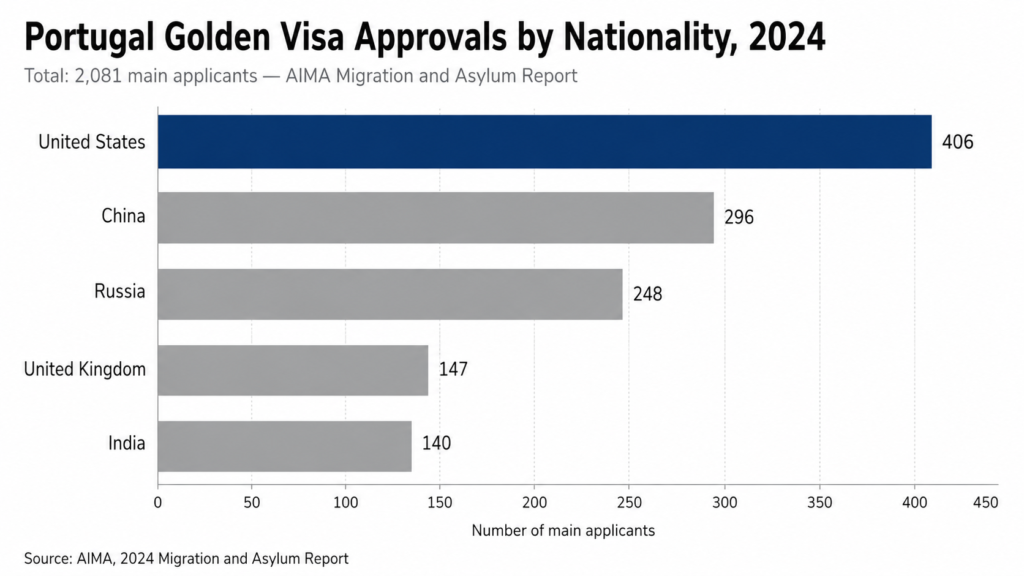
Americans are now the largest national group in Portugal’s Golden Visa program. AIMA’s official 2024 Migration and Asylum Report shows 406 Golden Visas issued to US nationals out of 2,081 total approvals, ahead of China (296), Russia (248), the United Kingdom (147), and India (140).
The American share has accelerated sharply. Industry analysis cited by Movingto.com and AOL puts US nationals at over 30% of all current Golden Visa approvals, up from roughly 5% five years ago. The number of Americans registered as residents in Portugal reached 20,959 in 2024, a near 50% increase from 2023.
This is why the collective lawsuit reads as an American story even though it involves multiple nationalities. The mathematics of the affected pool, the size of the deployed capital from US investors, and the public face of the WhatsApp organizing group all reflect a US-heavy demographic.
The AIMA Backlog Multiplies the Problem
The lawsuit is unfolding against a much larger administrative crisis. An estimated 20,000 Golden Visa investors are expected to be waiting for AIMA appointments in 2026 alone, Expresso reported, in coverage carried by Portugal Resident.
The Portuguese government confirmed in early 2025 that the broader immigration backlog had approached approximately 900,000 cases, and Minister of the Presidency António Leitão Amaro explicitly framed Golden Visa files as the lowest priority, telling lawmakers in October 2025 that the government left “those that pay the most” until the end.
A separate amicus curiae brief filed at Portugal’s Constitutional Court in December 2025 by 15 American Golden Visa holders described the administrative delays as “intolerable” and noted that some applicants have waited more than four years for a decision that the law requires within 90 days.
What the Investors Are Actually Arguing
The legal theory anchoring the lawsuit is the principle of legitimate expectations. Investors deployed substantial capital, typically €500,000 or more, in reliance on a published statutory framework that offered eligibility to apply for citizenship after five years. The state then changed the rules mid-process without extending grandfathering to residents who had not yet filed nationality applications.
According to Madalena Monteiro, the founder of Liberty Legal who filed the December amicus brief, potential legal pathways include state liability claims for damages, constitutional challenges in Portuguese courts, and eventual escalation to the European Court of Human Rights if domestic remedies fail. The investors have publicly stated their intention to “exhaust the Portuguese legal system” before pursuing European-level options.
Multiple law firms are representing the group, though most are advising clients to wait for the final implementing regulations before formally filing.
What This Means for Americans Considering Portugal
The practical implications for US investors fall into three categories.
For Americans already holding a Golden Visa or in the pipeline
The immediate question is whether to join the collective lawsuit or pursue an individual case. The collective action offers cost-sharing and visibility, but individual cases have historically been faster at forcing AIMA decisions on stalled files.
For Americans currently considering a Portugal Golden Visa application
The calculation has changed materially. The 10-year citizenship timeline, combined with the new residency-clock starting point, weakens Portugal’s position on the specific dimension of speed-to-passport, although the relevant comparison depends heavily on which alternative program is on the table. American investors are increasingly turning to Greece’s Golden Visa as the most direct EU alternative.
For Americans already residing in Portugal under other visa categories
The new Nationality Law applies broadly, not just to Golden Visa holders. The 10-year clock affects D7 retirees, D8 digital nomads, and ARI investors alike. Citizenship plans built around the old five-year framework are now subject to the same statutory uncertainty over residency-time crediting that drives the Golden Visa lawsuit.
The collective lawsuit will not be resolved quickly. Portuguese constitutional challenges and administrative court proceedings of this scale tend to move on multi-year timelines, and any escalation to European courts adds further years.
In the meantime, the regulatory clock keeps running: the government’s 90-day deadline to update the Regulamento da Nacionalidade Portuguesa lands in mid-August 2026, and AIMA’s implementing guidance on residency-time crediting is expected around the same window.