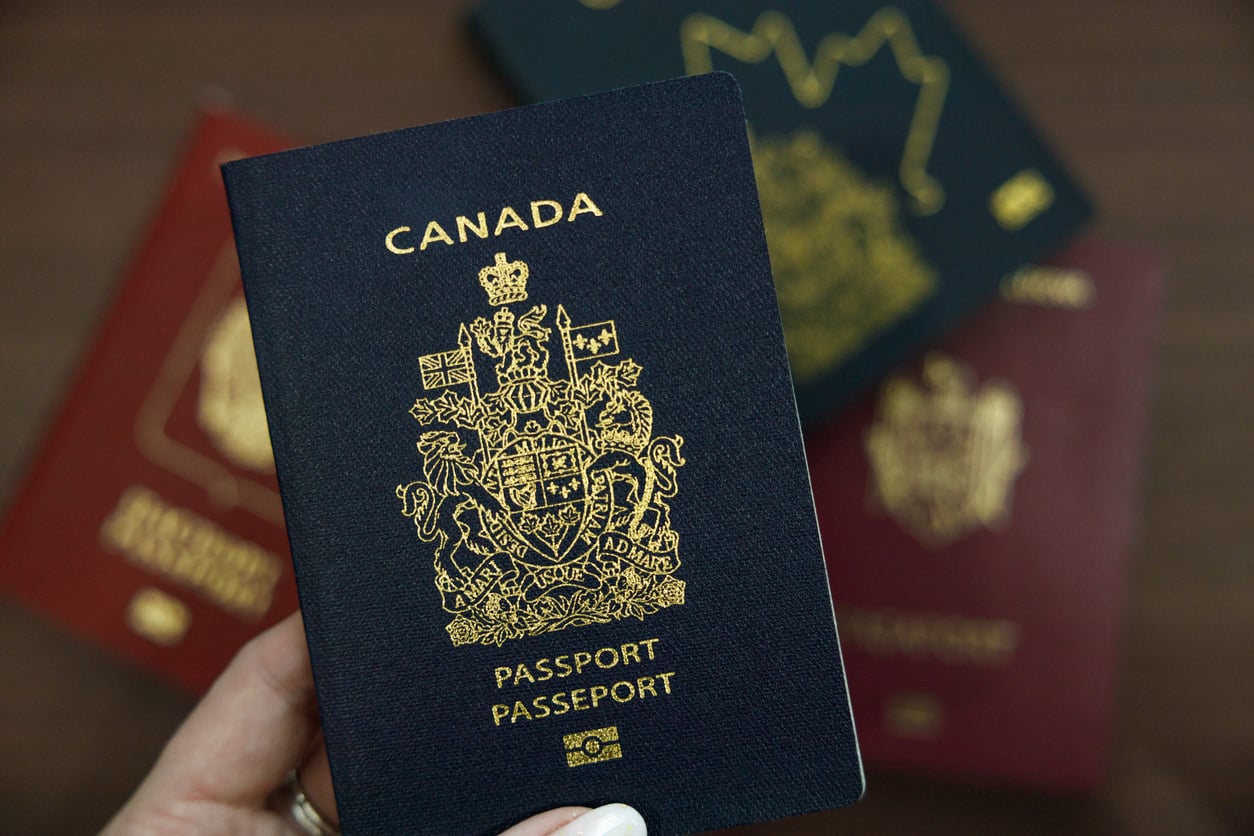


Canadian citizenship by descent just became one of the easiest second-passport routes available to Americans, and the country’s immigration agency has the application backlog to prove it. In January 2026 alone, nearly 2,500 Americans filed for proof of Canadian citizenship, ten times the figure from second-place United Kingdom and more than the next nine source countries combined.
The trigger is Bill C-3, which took effect Dec. 15, 2025.
The law removes the first-generation limit that had governed Canadian descent claims since 2009. Many people born abroad before Dec. 15, 2025 with a Canadian citizen in their direct line may now qualify, provided the chain is documentable and each parent in the chain meets the amended rules. The change is retroactive. People who qualify are already Canadian citizens under the law; what they apply for is a certificate proving it.
The 2009 cutoff and what replaced it
Before Bill C-3, Canadian citizenship by descent passed to one generation born outside Canada and stopped there. A Canadian-born parent could pass citizenship to a child born abroad. That child could not pass it to a grandchild born abroad. The grandchild had to apply through naturalization or family sponsorship.
That rule came from Bill C-37, passed under the Harper government in 2009. It created a cohort known as Lost Canadians: people with Canadian parents, grandparents or great-grandparents who fell outside the chain of descent. The Ontario Superior Court of Justice struck down the limit in December 2023 as a Charter violation of equality and mobility rights. The federal government declined to appeal.
Bill C-3 codifies the court’s logic:
- For many people born before Dec. 15, 2025, the first-generation limit no longer blocks citizenship by descent.
- For children born or adopted abroad on or after that date, a new “substantial connection” test applies: the Canadian parent must have lived in Canada for 1,095 days before the child’s birth. The 1,095 days do not need to be consecutive.
American applicants dominate the numbers
The American share of new descent applications is unmatched by any other country. Of the top ten source countries in January 2026, the United States contributed nearly 2,500 applications. The United Kingdom, in second place, contributed 290. France, China, Hong Kong, India, Australia, the Philippines, the United Arab Emirates and Germany filled out the rest of the list. The US total exceeded the combined filings of all nine.
That intensity tracks with pre-existing demand. In all of 2025, 24,500 Americans gained Canadian citizenship across all routes, roughly 30% of the global total. Genealogists tracking the eligible pool estimate that between 4 million and 7 million Americans now qualify under the descent rules, most of them unaware.
Provincial archives are seeing the front edge of the rush: the Bibliothèque et Archives nationales du Québec went from 32 vital-records requests in January 2025 to more than 1,000 a year later, almost entirely driven by American applicants.
The processing backlog is already growing
IRCC confirmed citizenship by descent for 1,480 people in the first six weeks after the law took effect. By late April 2026, more than 56,000 applications were awaiting a decision and processing times had stretched to around 10 months. Applications submitted from outside Canada add another three to four months for mailing.
The government’s own projections are split. The Parliamentary Budget Officer estimated in December 2024 that similar Citizenship Act amendments under predecessor Bill C-71 would affect roughly 115,000 people over five years at a net cost of $20.8 million.
The interim Parliamentary Budget Officer told the Senate’s Social Affairs Committee in November 2025 the assumptions behind that estimate remained sound for Bill C-3. Immigration Minister Lena Metlege Diab told the same committee a week later that IRCC expects tens of thousands of applications, not hundreds of thousands, citing the modest take-up after the 2009 and 2015 reforms.
What the numbers do and don’t show
The 56,000-application backlog is a measure of demand, not of relocation. Most newly eligible Americans will not move to Canada. They cannot vote in Canadian federal elections without being physically resident, cannot access provincial health coverage until they establish residency, and remain on the hook for US tax filing regardless of where they live.
What the certificate gives them is a Canadian passport, the right to enter and work in Canada without a visa, and the ability to pass citizenship to children born abroad if they meet the 1,095-day test going forward. Acquiring Canadian citizenship by descent is not an expatriating act under US law.
The application numbers do reveal something about American sentiment that other emigration indicators have not captured at this scale. Citizenship by descent costs little, requires no relocation and carries no commitment. It sits at the opposite end of the spectrum from Americans filing asylum claims in Canada, where the cost of acting on US political conditions is measured in legal jeopardy rather than paperwork.
Descent is the lowest-friction signal an American can send that they want a second option, and applicants quoted in Canadian and US wire coverage have cited US political conditions as the proximate trigger. The 10-to-1 ratio against the next-highest source country is the data point worth tracking.