



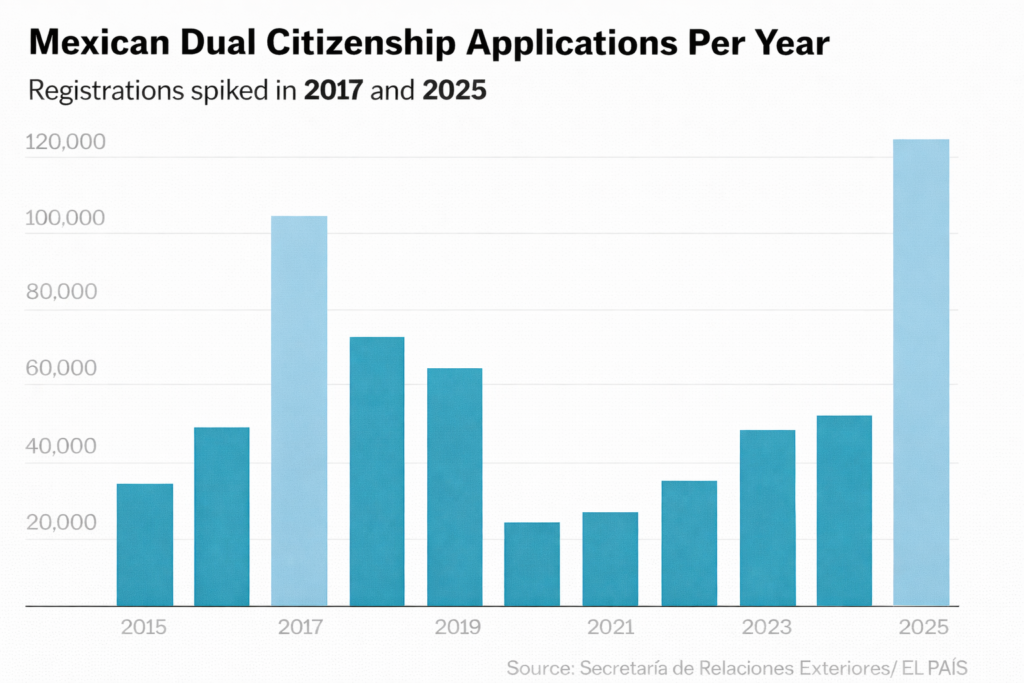
More than 125,000 people obtained Mexican nationality through consulates in the United States in 2025, a 153% increase over 2024 and more than the combined total of the three preceding years, according to Mexico’s Secretariat of Foreign Affairs. The vast majority are U.S. citizens or long-term residents who had a Mexican-born parent but had never formalized the connection on paper.
Both times registrations topped 100,000 in a single year, the catalyst was the same: the opening year of a Trump administration. The first spike came in 2017. The second came in 2025.
How It Works
Mexican law has permitted dual nationality since 1998. Anyone born in the United States to at least one Mexican parent is entitled to Mexican nationality by registering at a consulate and producing a birth certificate. Once registered, a person can apply for a Mexican passport, vote in Mexican elections, access public services in Mexico, and gain consular protection.
That last point is what has changed the calculus for many families. If Mexican-born parents are deported while a minor child holds only U.S. citizenship, the family faces forced separation, because Mexican authorities cannot intervene on behalf of someone who is not registered as a Mexican national. For mixed-status families, formalizing their children’s nationality is risk management.
Where It Is Happening
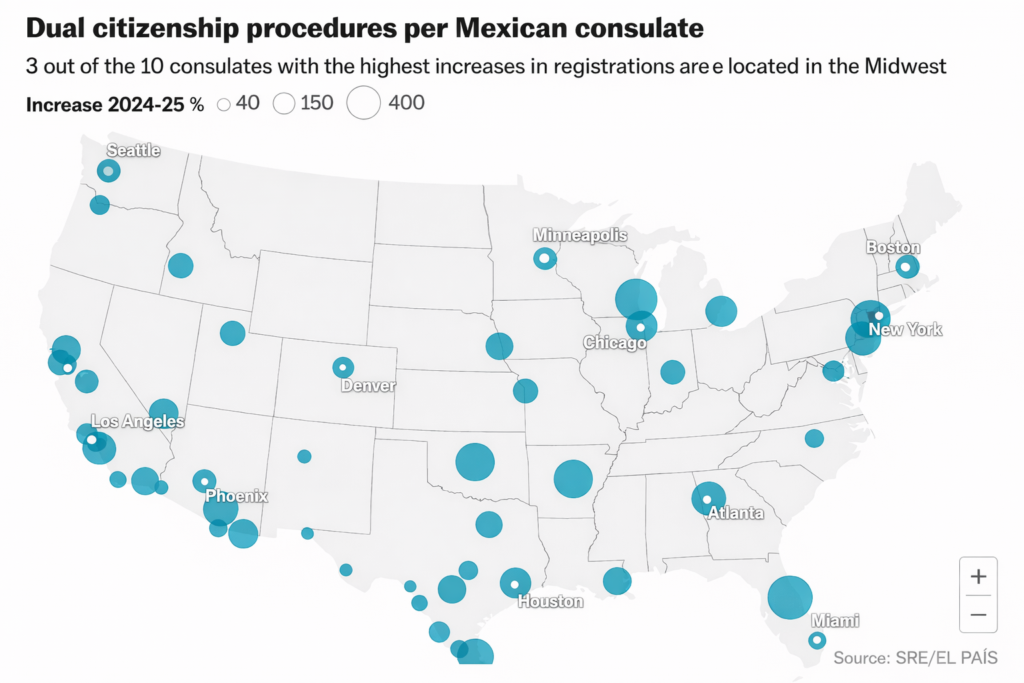
The geography is revealing. Consulates in Orlando and Milwaukee posted increases of 444% and 333% respectively, and three of the ten fastest-growing consulates sit in the Midwest. Texas tells its own story: one in five of all dual nationality procedures in 2025 ran through the state’s eleven consulates. Houston alone processed nearly 11,000 cases, roughly triple its 2024 volume. In Denver, the consulate tripled the size of its processing team.
A consul general in Laredo offered a useful analogy in an interview with Spectrum News: obtaining dual nationality is like buying car insurance. You are not expecting to crash. You are preparing in case you need it.
The Network
Mexico operates the largest consular network any country maintains on foreign soil: 53 consulates across 31 states and Puerto Rico, serving more than 40 million people of Mexican origin. That infrastructure was already in place when demand surged, which is part of why the system absorbed the increase as well as it did. The Mexican government’s Know Your Rights program has also expanded outreach, encouraging eligible individuals to apply as a form of legal preparedness.
The Trump administration’s pressure on sanctuary cities has extended the climate of uncertainty well beyond the border states that dominate the immigration conversation. Families in places like Milwaukee and Orlando are now thinking about contingency plans they might otherwise have deferred indefinitely.The geography is revealing. Consulates in Orlando and Milwaukee posted increases of 444% and 333% respectively, and three of the ten fastest-growing consulates sit in the Midwest. Texas tells its own story: one in five of all dual nationality procedures in 2025 ran through the state’s eleven consulates. Houston alone processed nearly 11,000 cases, roughly triple its 2024 volume. In Denver, the consulate tripled the size of its processing team.
A consul general in Laredo offered a useful analogy in an interview with Spectrum News: obtaining dual nationality is like buying car insurance. You are not expecting to crash. You are preparing in case you need it.
The Network
Mexico operates the largest consular network any country maintains on foreign soil: 53 consulates across 31 states and Puerto Rico, serving more than 40 million people of Mexican origin. That infrastructure was already in place when demand surged, which is part of why the system absorbed the increase as well as it did. The Mexican government’s Know Your Rights program has also expanded outreach, encouraging eligible individuals to apply as a form of legal preparedness.
The Trump administration’s pressure on sanctuary cities has extended the climate of uncertainty well beyond the border states that dominate the immigration conversation. Families in places like Milwaukee and Orlando are now thinking about contingency plans they might otherwise have deferred indefinitely.
What the Numbers Mean
The 2025 registrations are not a leading indicator of emigration. They are citizenship filings, not moving plans. What the data captures is a shift in how Mexican-American families are managing legal risk, a paper trail left by people preparing for a future they are not sure will require those documents, but no longer feel certain it won’t.
The 2017 surge followed the same pattern. Registrations spiked, then gradually came back down. Whether the 2025 numbers mark the beginning of a longer trend or the peak of a reactive one will depend on what happens next in Washington.