
The number of US citizens in Czechia reached 10,701 on Jan. 1, 2025, up from 7,157 just two years earlier. That’s a 49% rise over the two-year stretch, and it lands the American resident count at its highest point in the Eurostat record that runs back to 1998, clearing the previous peak of 9,113 set in 2017.
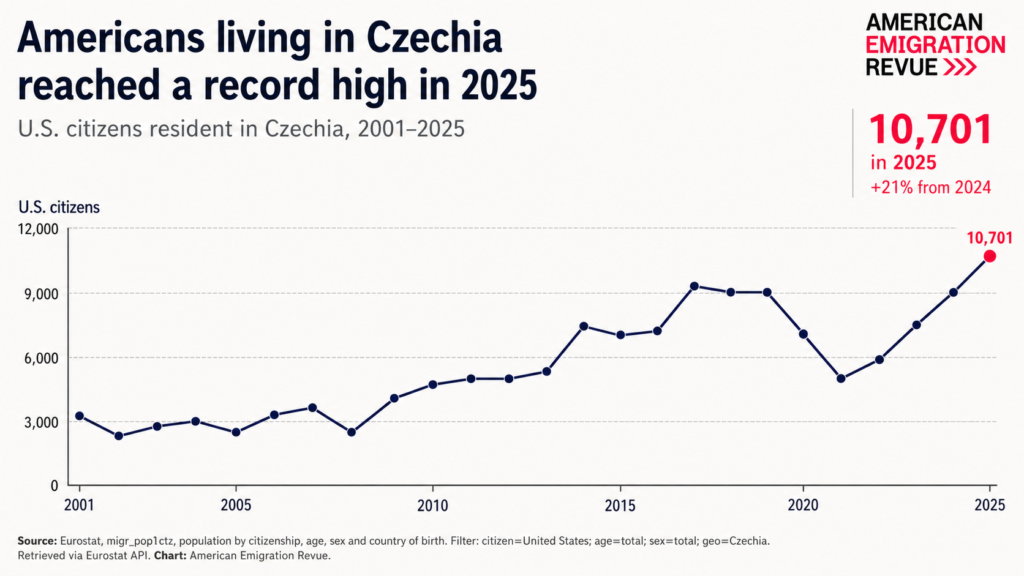
The recent slope is steep, not steady. The count stood at 4,971 on Jan. 1, 2021, which means the American population has more than doubled in four years, climbing through 5,722 in 2022, 7,157 in 2023, and 8,820 in 2024 before crossing 10,000.
The Eurostat series, which counts usual residents by country of citizenship on Jan. 1 each year, tracks people rather than entries, so it reflects who stays as much as who arrives.
Why Prague does most of the pulling
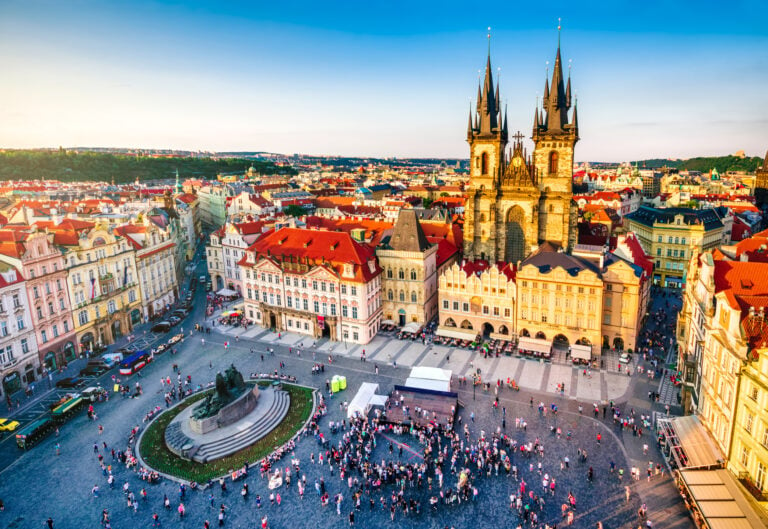
Most of this resident stock sits in one city. Prague holds the country’s English-language job market, its international schools, and the freelance and tech ecosystem that draws remote workers, and it absorbs the bulk of the American arrivals each year.
The draw is practical as much as romantic. Rents and daily costs run below Western European capitals, the city sits inside the Schengen zone, and a settled American community lowers the friction of a first move abroad. Prague competes for the same cohort that has made Portugal a European base for remote workers.
The residence routes behind the count
Americans cannot simply move in and stay. The two common long-stay paths are a long-term visa for self-employment, built on a Czech trade license known as the zivnostenske opravneni, and a digital nomad route the government opened July 1, 2023, under Government Resolution No. 475 of June 28, 2023.
The trade license costs about 1,000 koruna (about $45) and registers a freelancer to bill clients legally. The digital nomad track fast-tracks long-term visas for remote workers in IT and marketing, expanded Feb. 24, 2025, to add applicants from Brazil, Israel, Mexico and Singapore alongside the United States.
Both routes lead toward a long-term residence permit, and time held under them counts toward the five-year mark for permanent residence. These visa pathways shape who shows up in the count of US citizens in Czechia each January.
What the stock counts, and what it misses
This figure is a stock, a snapshot of US citizens usually resident on a single day, not a flow of new movers. It counts passport, not birthplace, so naturalized Americans born elsewhere sit inside it and US-born residents who took Czech citizenship can drop out of it.
The series carries one caution worth naming. Eurostat flags a break in the data at 2021, the point where the 2021 Czech census recalibrated how the statistics office counts foreign residents. The break sits directly on the American line.
The count of US citizens in Czechia dropped from 8,937 in 2019 to 4,971 in 2021 across that revision, which means the pre-2021 and post-2021 stretches are not a single clean ruler, and the 2017 peak and the 2025 record are measured on slightly different terms. What is not in dispute is the direction since the reset, a 115% climb in four years.
A residence count, not a citizenship wave
The 10,701 figure describes US citizens in Czechia who hold residence, not Americans who have traded a passport. Czech naturalization is a separate and slower track, and the December 2025 US proposal to curb dual citizenship, parked in the Senate Judiciary Committee with low odds of advancing, has not moved the resident numbers.
What the data shows is a fast-recovering and now record-large community, anchored in Prague, built on the kind of visa routes that have pulled Americans across Europe and that reward people who stay. The count has more than doubled since 2010, and nothing in the residence framework points to a reversal.