



Thousands of court cases are backing up Portugal’s immigration authority AIMA, and the resulting Portugal residence permit delays are landing on Americans mid-application. The agency was still working through thousands of outstanding court decisions in May 2026, slowing permit issuance for new residents. The squeeze comes at an awkward moment. Portugal’s American population has never been larger.
The Agency for Integration, Migration and Asylum (AIMA) counted 19,258 US citizens legally resident in Portugal in 2024, up 36.3% from 14,129 a year earlier, the agency’s annual migration report shows. That cohort sits inside a permit system that has spent two years in triage.
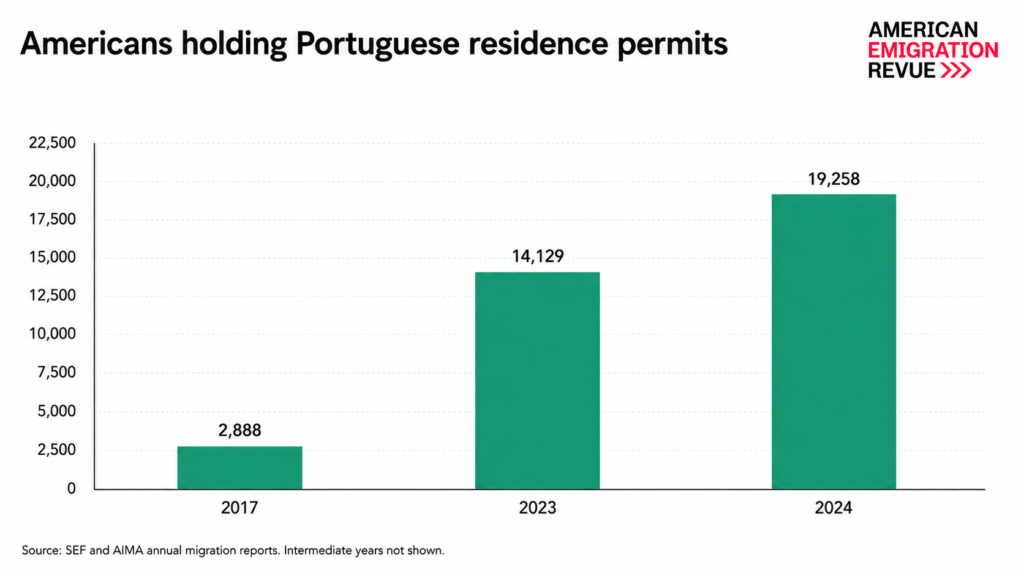
The court docket driving the slowdown
AIMA inherited roughly 400,000 pending files when it replaced the dissolved border agency SEF in October 2023. Applicants tired of waiting found a workaround: sue. Portuguese law lets courts order AIMA to issue a decision within a set deadline, and lawsuits naming the agency in Lisbon’s administrative tribunal passed 133,000 by mid-October 2025, triple the 2023 volume, per reporting on agency data.
The litigation is now coming from a second direction.
More than 500 golden visa investors, most of them American, are organizing a collective lawsuit against the Portuguese state after Lei Orgânica nº 1/2026 doubled the citizenship timeline to 10 years without grandfathering residents who hadn’t yet filed for nationality. Those cases would land in the same administrative court system already ordering AIMA decisions.
The individual suits work for the plaintiff. They clog the pipeline for everyone else. Each court-mandated case jumps the queue, and AIMA now runs two parallel workloads: the judicially ordered decisions and the ordinary flow of new appointments and renewals.
Nearly 130,000 residency files were still awaiting a final outcome as of late 2025, including renewals and CPLP permits.
Where American applicants feel it
Americans enter this system mostly through the D7 passive-income visa, the digital nomad visa and the golden visa. US citizens led digital nomad visa requests in 2023 and 2024 and topped golden visa concessions in 2023 with 567 approvals, Público reported.
All three routes converge on the same chokepoint: the in-person AIMA appointment where applicants submit biometrics and confirm their file. Documents that were accurate at the consular stage, bank statements, lease agreements, employment records, can go stale during a long wait. Files flagged as incomplete or outdated trigger requests for additional evidence and sit in queue again. AIMA has reportedly enforced a strict complete-application policy since late 2025; a missing document means rejection and a new appointment.
The agency has tried to take pressure off legal status itself. Residence permits that expired before June 30, 2025, were extended to April 15, 2026, and AIMA added a further 60-day extension this spring while it works the backlog down. The extensions hold only inside Portugal. An expired card is not valid for Schengen travel.
What the data does and doesn’t show
The American growth curve is steep but the base remains small. The 19,258 Americans recorded in 2024 represent under 2% of Portugal’s roughly 1.5 million foreign residents, and Portugal still trails the UK, Germany, France and Spain as a destination for US citizens in Europe. The delays are a systems story, not an American story; the cohort is simply growing fast enough to feel it disproportionately at the permit stage.
What no public figure yet shows is the average wait an American D7 or digital nomad applicant faces in mid-2026. AIMA reports backlog clearance rates above 90% on inherited files, while complaint volumes and new lawsuits keep climbing.
Both things can be true. The agency is closing old cases faster than it is keeping current ones from stalling, and until the court docket clears, the appointment remains the slowest step between a US passport and a Portuguese residence card.