

American residence permits in Mexico concentrated in three federal entities in 2024, with Mexico City, Jalisco and Baja California Sur accounting for 40% of national permit activity from January through October, according to the Instituto Nacional de Migración’s permit database. The top six entities together carried 63% of the 23,502 events recorded over the 10-month window, a concentration that aligns with the established American settlement corridors.
The pattern matters because Mexico’s residency rules changed substantially in January 2026, raising both qualification thresholds and government fees for the first time outside the usual inflation track. The 2024 distribution is the baseline against which the post-reform inflow will be measured.
Where American residence permits in Mexico concentrate
The January through October 2024 INM permit events to US nationals broke down by federal entity as follows:
- Mexico City (CDMX): 3,551 events (15.1%), capital concentration
- Jalisco: 3,180 events (13.5%), including Puerto Vallarta and the Chapala lakeside corridor
- Baja California Sur: 2,707 events (11.5%), including Los Cabos and La Paz
- Quintana Roo: 2,346 events (10.0%), including Cancún and Cozumel
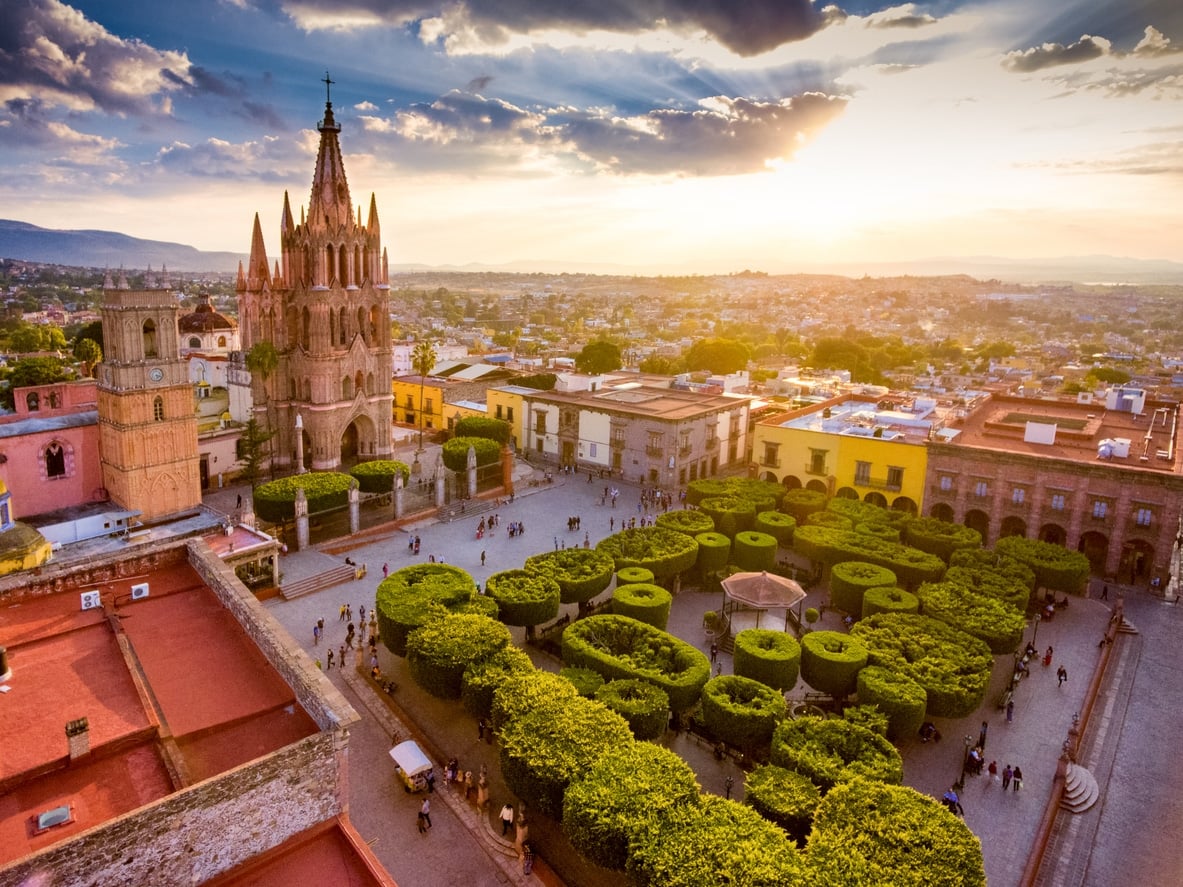
- Guanajuato: 1,590 events (6.8%), including San Miguel de Allende
- Yucatán: 1,497 events (6.4%), including Mérida and Progreso
These are permit issuance events, not unique persons; one applicant can generate multiple events across a calendar period. They’re a flow measure, not a stock. The residual 8,631 events split across the remaining 26 federal entities, none accounting for more than 4%.
The geography tracks decades of Lifestyle Migration patterns: capital pull in Mexico City, the established American corridor around Lake Chapala and Puerto Vallarta, the resort-and-retirement zones in Los Cabos and Cancún, and the heritage-city retirement clusters in San Miguel de Allende and Mérida.
The 2026 reform changed the math
Mexico’s government published updated immigration guidelines in the Diario Oficial de la Federación in July 2025, replacing the minimum-wage-based qualification formula with one indexed to the Unidad de Medida y Actualización (UMA). The changes took effect January 1, 2026. The reform reshapes the qualification math for American residence permits in Mexico across all four economic-solvency routes. UMA for 2026 is set at 117.31 pesos per day, a 3.69% increase over 2025.
Two shifts hit American applicants directly:
- Income and savings thresholds rose: Temporary residency now requires roughly $4,400 a month in income or $74,000 in savings averaged over the qualifying window. Permanent residency requires roughly $7,400 a month or $300,000 in savings.
- INM fees roughly doubled: A one-year temporary resident card now costs about 11,140 pesos ($620), up from about 5,328 pesos ($296). Total government fees for the five-year journey from temporary to permanent residency exceed 50,000 pesos ($2,800) per applicant, up from about 25,000 pesos before.
The reform also formalized stricter documentation review. Applicants now must provide at least two documents proving Mexican residential address, and INM offices have been issuing one-year renewals where applicants requested three. The shift to UMA stabilizes the year-over-year track, but the rebasing made the entry point higher.
The footprint behind the flow
The INM permit data captures who’s arriving and renewing legal status. It doesn’t capture the full American presence. Mexico’s 2020 INEGI census recorded 797,266 US-born residents, a 132% increase from 343,591 in the 2000 census. That count includes naturalized Mexicans, dual citizens born in the United States, and long-settled Americans who never formalized residency.
A separate AE analysis found over 125,000 people obtained Mexican-American dual citizenship in 2025 alone, most through Mexican citizenship granted to American-born children of Mexican nationals. The US-born population in Mexico is the largest American footprint in any country in the world by a wide margin. The INM permit pipeline is a fraction of that footprint, capturing mainly first-generation American migrants who arrive as adults.
What this tells us about Americans in Mexico
Mexico’s American story is two stories. The first is the diaspora, 797,266 strong as of the 2020 census, concentrated in Baja California, Jalisco, and the northern border states, much of it born of cross-border family ties going back generations. The second is the lifestyle migration overlay, captured in the INM permit data, concentrated in CDMX, Jalisco, BCS, and Quintana Roo, and built around remote workers, retirees, and Americans pursuing lower cost of living.
The 2026 reform raises the entry bar on new American residence permits in Mexico without touching the diaspora footprint. Whether the higher thresholds slow the INM permit flow or simply shift its composition toward higher-income applicants is the question the next reporting cycle will answer. The 23,502 figure for the first 10 months of 2024 is the pre-reform baseline.