
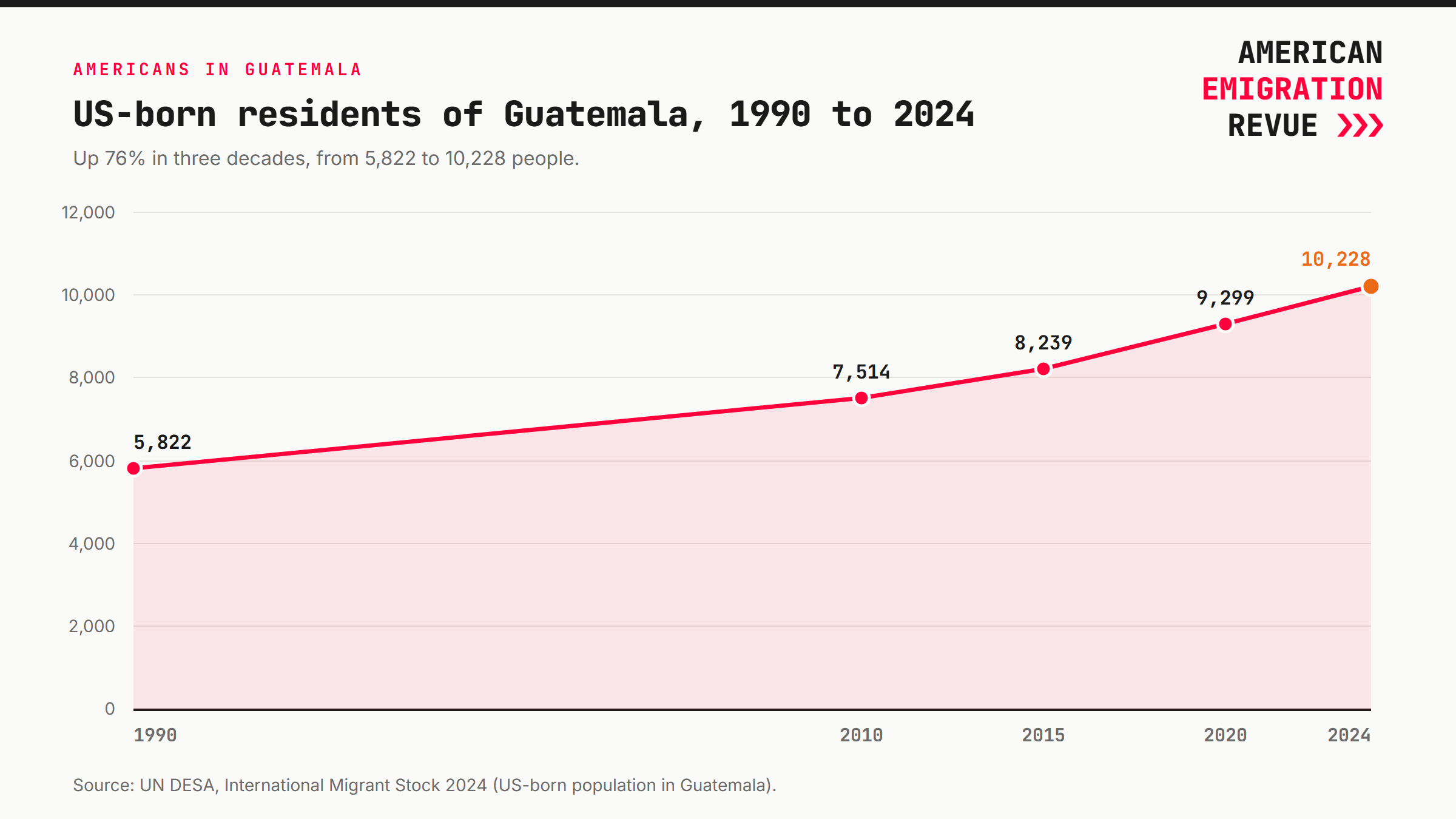
For decades, the most reliable count of Americans in Guatemala came from outside the country: United Nations estimates put 10,228 US-born residents there in 2024, up from 9,299 in 2020 and 5,822 in 1990. That’s a near doubling across three decades, drawn not from a Guatemalan registry but from a global model.
The slope is real. The hard local data behind it is thin.
Guatemala’s own census offers the cleanest domestic measure, and it lands close. The 2018 count run by the Instituto Nacional de Estadistica (INE), the national statistics office, recorded about 82,120 foreign-born residents, and people born in the United States made up 15.7% of them, roughly 12,900 people.
That was the second-largest origin group in the country, behind El Salvador at 28.6% and ahead of Mexico and Honduras.
Why the count of Americans in Guatemala is so hard to pin down
Three figures describe the same population and none of them match. The 2018 census says about 12,900 US-born residents. The UN model says 10,228 for 2024. US State Department consular estimates, cited by relocation services, put the figure near 9,000 in early 2026.
The spread is not a contradiction so much as three different instruments. The census counts people physically present and born in the US on one night in 2018. The UN figure is a modeled stock that leans on census inputs and interpolates between them.
The consular estimate counts citizens who register or surface through embassy contact, which always undercounts. A dual citizen born in Guatemala, raised in the US, and returned home may appear in one frame and vanish from the others.
What Guatemala publishes, and what it doesn’t
The agency that would seem the obvious source publishes almost nothing on this. The Instituto Guatemalteco de Migracion (IGM), the country’s migration authority, releases steady statistics on Guatemalans deported from the US and Mexico, more than 27,000 returnees in the first months of 2026 alone, plus entries, exits and border refusals.
What it does not routinely publish is a standing count of foreign nationals living in Guatemala broken out by country, the mirror-image number that would track Americans settling in. So the resident-American figure falls back to the census, taken once and now eight years old, and to the UN’s modeled series.
There is no monthly or annual administrative count of US citizens holding Guatemalan residence the way Mexico or Portugal report permits.
A small population that keeps growing
The numbers are modest by any measure. Even the highest estimate sits under 13,000 in a country of more than 18 million. Set against the nearly 1.3 million Guatemalan immigrants in the US, the reverse flow is a rounding error.
Direction matters more than scale here. Every available series points the same way over time: the US-born population in Guatemala has climbed steadily since 1990, with the UN figure rising about 36% between 2010 and 2024. The trend is consistent even where the levels disagree.
What the gap says about the data, not just the migrants
The honest read is that no Guatemalan source counts resident Americans with precision, and the three numbers that exist diverge by up to a third for that reason. The census is dated, the UN figure is modeled, the consular tally undercounts.
For a fuller picture of where Americans are settling abroad, Guatemala is a reminder that the absence of a clean administrative count is itself the finding.
What can be said with confidence is narrow and still useful. Americans are the second-largest foreign-born group in Guatemala, their numbers have grown for 30 years, and the best single domestic measure remains a census now overdue for replacement.
Until Guatemala publishes a current residence count by nationality, the slope is solid and the level is an estimate.