The Internal Revenue Service published 1,462 names on its latest quarterly list of US citizenship renunciations, covering the first quarter of 2026. That’s a 13.8% increase over the same quarter of 2025, and the second-highest quarterly total in the past year. The pace matters because it was set before renouncing got cheaper.
The full-year picture shows a plateau at an elevated level. The four quarterly lists covering 2025 contain 4,889 names, up 1.5% from 4,818 in 2024. Both years sit well below the pandemic-era peak, when consular backlogs compressed years of demand into a handful of quarters.
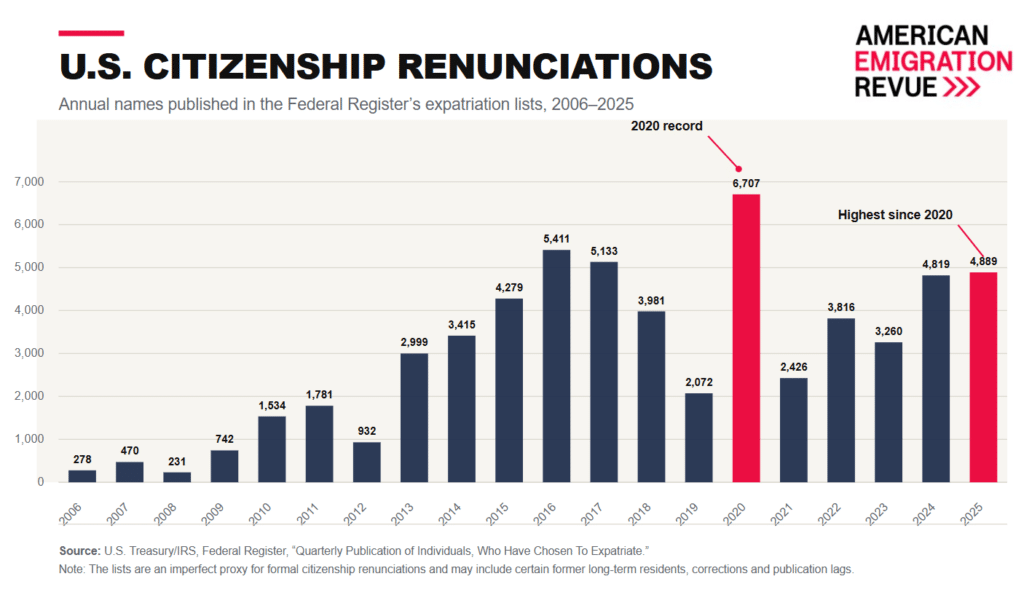
What the quarterly list actually counts
The IRS publishes the list each quarter under section 6039G of the tax code, naming each individual who lost US citizenship during the period. The count is broader than the word renunciation suggests. It also includes long-term permanent residents who gave up their green cards after holding them for eight of the last 15 years, since the tax code treats them as if they were citizens who expatriated.
The list is also slow. Names often appear one or more quarters after the underlying renunciation, so quarterly totals reflect when the Treasury processed the paperwork, not when Americans walked into a consulate. Quarterly figures swing accordingly:
- Q1 2025: 1,285 names
- Q2 2025: 1,057 names
- Q3 2025: 1,593 names
- Q4 2025: 954 names
- Q1 2026: 1,462 names
The State Department’s Certificate of Loss of Nationality records, which researchers consider the more direct measure, aren’t published on a comparable schedule. The two counts diverge for methodological reasons, not because either is wrong.
Taxes and banking dominate the official record
The clearest documented evidence of motive sits in the State Department’s own rulemaking file. When the department cut the fee for renunciation paperwork from $2,350 to $450 in a final rule published March 13, it summarized 910 public comments. Commenters described paying hundreds or thousands of dollars a year to tax professionals for returns that produced no US tax liability.
Others reported being refused mortgages, mutual funds and ordinary bank accounts in their countries of residence.
The department acknowledged what it called “not insignificant anecdotal evidence” of tax-related difficulties faced by Americans abroad, including difficulties tied to the Foreign Account Tax Compliance Act. FATCA requires foreign banks to report accounts held by US citizens, and many banks respond by closing those accounts instead. The United States and Eritrea are the only countries that tax on the basis of citizenship rather than residency.
The rule also recorded something the raw counts can’t. Most commenters said they didn’t want to give up their citizenship at all. They wanted to remain American but found the compliance burden incompatible with an ordinary financial life abroad.
Politics drives the firmest decisions
Survey data point to a second motive that the rulemaking file understates. A March 2026 poll of 200 Americans surveyed in Portugal found 49% would at least consider renouncing once they obtain a Portuguese passport. Among respondents firmly committed to renouncing, 83.1% cited political disenchantment as a primary driver. Tax complexity ranked highest among those already living in Portugal, at 38.5%.
The two motives operate on different timelines. Political frustration pushes Americans to leave; tax and banking friction pushes those already settled abroad to formalize the break.
The cheaper fee hasn’t shown up in the data yet
The $450 fee took effect in mid-April, roughly two weeks after the first quarter closed. Every name on the Q1 2026 list paid, or was in line to pay, the old $2,350 charge, the highest expatriation fee in the world at the time. The 13.8% year-over-year increase happened under the old price.
The Q2 2026 list, due in late July based on the Treasury’s recent publication schedule, will be the first covering renunciations processed under the lower fee. Even that list will only partly capture the change, given reporting lags and consular appointment backlogs that add costs well beyond the fee itself.
What the renunciation data does and doesn’t show
The lists confirm a steady, elevated outflow: roughly 4,800 to 4,900 expatriations a year for two consecutive years, with early 2026 running ahead of the year-earlier pace. They don’t show how many Americans want to renounce but haven’t, a group the State Department’s own comment file suggests is substantial.
The next two quarterly lists will show whether an 81% price cut converts that pent-up demand into names.