

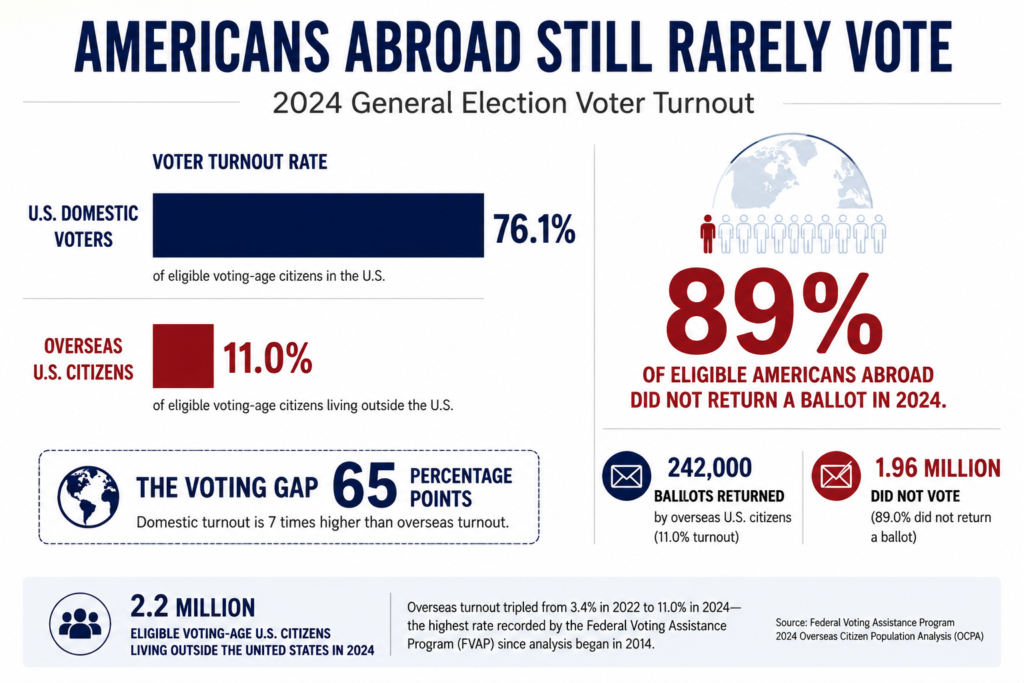
Overseas voter turnout tripled in the 2024 General Election, but the new high-water mark still left 89% of eligible Americans abroad on the sidelines. About 11.0% of the estimated 2.2 million voting-age U.S. citizens living outside the country returned a ballot, according to the Federal Voting Assistance Program’s 2024 Overseas Citizen Population Analysis. Domestic turnout that year was 76.1%.
The 65-point gap between the two groups is what FVAP calls the voting gap. It survived a presidential cycle in which both major parties spent unprecedented energy chasing overseas ballots.
A tripling, off a very low base
In 2022, an estimated 3.4% of eligible overseas voters returned a ballot. That rate had been slightly lower than the 4.7% recorded in 2018. The 2024 figure of 11.0% is the highest FVAP has recorded since it began the biennial analysis after the 2014 General Election.
Some of the jump tracks the normal pattern: presidential years draw more voters than midterms, abroad and at home. Even so, the 2024 rate sits well above the 9.0% returned in 2020 and the 9.2% returned in 2016, when FVAP first calculated overseas turnout. The full series, drawn from FVAP estimates and reproduced in the public Wikipedia compilation, looks like this:
- 2014 midterm: 4.3%
- 2016 presidential: 9.2%
- 2018 midterm: 5.6%
- 2020 presidential: 9.0%
- 2022 midterm: 3.4%
- 2024 presidential: 11.0%
The new high still translates to roughly 242,000 returned ballots out of 2.2 million eligible voters.
What the obstacle gap is and isn’t
FVAP splits the difference between domestic and overseas turnout into two pieces. The “obstacles gap” captures voters who tried and failed, or who decided the process was too costly to attempt. The “residual gap” captures voters who didn’t want to vote at all. In 2024, FVAP attributed roughly 20.6% of the gap to real or perceived obstacles, the agency said.
The remaining four-fifths sits in the residual category. That is the data point worth lingering on. Overseas Americans are roughly seven times less likely to cast a ballot than stateside Americans, and most of the gap isn’t about postage or paperwork. It’s about disengagement.
The launch essay for the American Emigration Revue flagged this pattern in 2024, observing that Americans who acquire foreign citizenship and register in foreign residency databases often do not maintain U.S. voter registration. The 2024 OCPA quantifies the gap; it doesn’t close the question of why.
Battleground state math
The DNC made what it described as a first-of-its-kind investment in overseas mobilization for the 2024 cycle, sending $300,000 to Democrats Abroad to fund registration drives, mail-in ballot operations and social media outreach. The party estimated 1.6 million eligible overseas voters held legal voting residence in seven battleground states: Arizona, Georgia, Michigan, Nevada, North Carolina, Pennsylvania and Wisconsin. In 2020, Joe Biden’s combined margin across Arizona, Georgia and Wisconsin was roughly 44,000 votes.
Donald Trump pursued the same constituency differently. In October 2024, he proposed ending what he called the double taxation of Americans abroad, the practice under which the United States taxes the worldwide income of its citizens regardless of residence. Neither campaign released turnout data specific to its overseas registration drives.
The 11.0% rate represents a tripling against the 2022 midterm, when overseas turnout collapsed to 3.4%. Whether the 2024 surge marks a structural shift or a one-cycle response to a high-salience election is the question the 2026 midterm will answer.
Where the eligible voters are
The 2.2 million voting-age figure sits inside an estimated 3.3 million total overseas citizen population in 2024, FVAP said. The largest concentrations of voting-age Americans live in Canada and the United Kingdom, with substantial populations in France, Israel and Australia.
The agency notes that overseas voter behavior also varies sharply by country, with the obstacle gap concentrated in Eastern Europe, parts of Asia, South and Central America, the Caribbean, and Africa.
The 2024 OCPA drew on a survey of 5,814 overseas citizens who requested an absentee ballot, FVAP said, the only representative survey of this group conducted by any U.S. government body. American Emigration Revue’s analysis of Americans acquiring Luxembourgish citizenship found a comparable pattern in microcosm: a population using its second nationality operationally, in housing, schooling and tax planning, while showing limited evidence of continued U.S. civic participation.
What this tells us about Americans abroad
Roughly 2.2 million eligible voters in 2024 had concentrated electoral leverage in close states and exercised it at a rate seven times lower than their stateside counterparts. The DNC’s $300,000 bet and the surge to 11.0% turnout both register as small numbers against the size of the eligible pool.
The 89% who didn’t vote is the structural fact. Whether the 2026 midterm reverts to the 3.4% pattern or holds closer to the 2024 mark will determine whether overseas Americans become a contested constituency or remain a demographic that politicians describe in press releases and ignore in budget allocations.