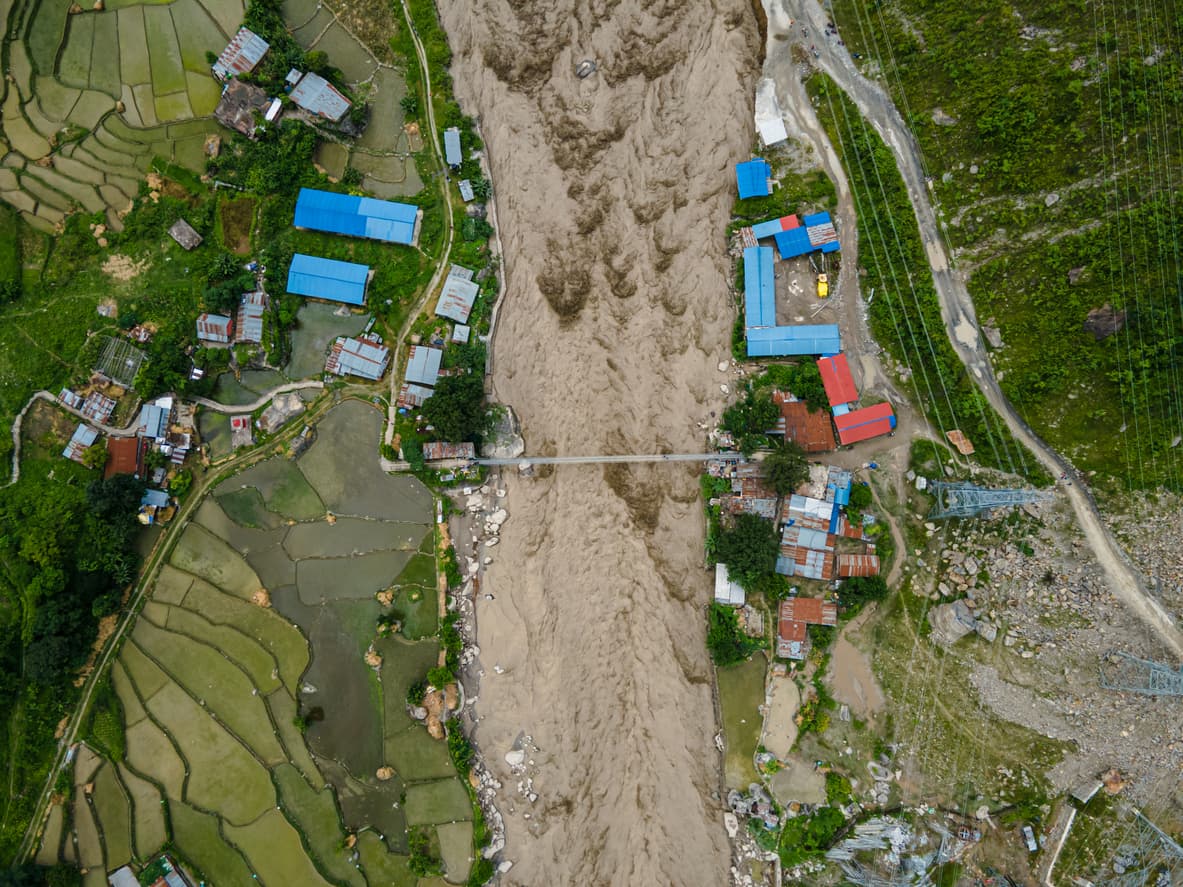
About 90 Americans remained unaccounted for after flash floods tore through the Nepal-China border region on Aug. 26, US officials said Aug. 27. Three Americans have been rescued and the State Department is not aware of any US deaths, the agency said in a statement.
The figure had not been publicly revised by Aug. 29.
It climbed for two days as families called in. Officials counted 33 Americans on Aug. 26, then 47, then 65, then about 90 by the evening of Aug. 27. Many of the missing were on a pilgrimage to Mount Kailash, a Tibetan peak sacred to Hindus, Buddhists and others.
Nine minutes at the border crossing
The Isha Foundation, a nonprofit spiritual organization with its North American headquarters in McMinnville, Tenn., said 22 Americans were among a group of 77 followers and three volunteers caught in the flood. The group had just finished a two-week trek and returned to an immigration center near the border.
They arrived at 9:05 a.m. Aug. 26. Water rushed in at 9:14 a.m.
"The area they were in was really hit by great force," said Leslie Crespi, a community liaison with the foundation. "The valley at the location they were in is buried under tons of debris right now."
Chinese government personnel and excavation equipment have started digging through the silt at the site, Crespi said. The foundation has notified all affected families and has a team in the area. One member of the group was from Tennessee, the foundation said, declining to say where.
A California couple ran for higher ground
Anjana Raja was on a bus with her husband heading toward the Chinese border when the driver and the passengers in front of her fled the vehicle. She had wanted to make the trip to Mount Kailash since she was a teenager.
"It was water mixed with the mud that was a good 50 to 60 feet high. It stood like a serpent right there staring at us," Raja told ABC News. "Like a cobra's head staring at you."
She grabbed her husband, Pattabiraman Venkatesan, by the collar. "I said, 'Run, we need to go right now.'"
The couple and other passengers scrambled to a camp beside the bus and climbed. "We didn't even know what direction. There was no guide for us, there was nobody, we were just frantically running," Raja said. From the third level of the camp they watched the water take the bus they had been sitting in.
"It just came like a roar, it sucked a bunch of buses, SUVs, people, the basecamp, everything," she said.
Raja, a mother of two from California, reached her daughter Amanda, a physician, once the couple got clear. She praised the rescuers who reached them. "What I really loved is his focus was not foreign nationals, nor US citizens," she said. "He looked at us as humans."
She and her husband intend to go back and finish the pilgrimage.
Why families face a long wait
Three Americans have been rescued, and the State Department said Aug. 27 it was not aware of any US deaths. It hasn't publicly revised that since, and the conditions on the ground explain why the number may not move quickly.
Bodies have washed far downstream and are being recovered in poor condition. Morgues in Nepal are overwhelmed. Authorities are collecting DNA samples to identify the dead and notify relatives.
In Chitwan district, where a number of bodies have washed up, police officer Anil Thapa told Reuters that more than half of those recovered were beyond recognition. "Many have no visible faces," he said. "In some cases, only hands or legs remain."
The toll keeps climbing
Nepal's disaster agency put the death toll at 752 on Aug. 30, with more than 2,500 people missing inside the country, 592 of them foreign nationals. The Nepal Tourism Board said 261 foreign nationals have been rescued.
China separately reported 16 dead and 546 missing in Tibet. How far the two countries' missing-person lists overlap isn't clear.
New warnings send residents back to higher ground
A landslide-dammed lake above the border checkpoint is overflowing, and heavy rain has pushed river levels up again. Nepal's flood alert system measured heavy rainfall across watershed areas of Gandaki Province on Aug. 30 and warned that levels were expected to rise.
Residents along the Trishuli River have fled their homes more than once. Aid workers are moving into the worst-hit areas as fast as conditions allow.
"The flood that came down that mountain just wiped out cities," said Ferrin Cole, an operations director at Crisis Response International, a US-based group working in Nepal. Mud makes the work dangerous, he said. "The longer that death and mud are together, diseases breed."
"Sometimes they say a flood is coming, then we have to run again to higher ground, even at night," Govind Shreshta, a resident of Galchhi, told the Associated Press. "I have a 72-year-old father and 70-year-old mom. I must carry them and I am exhausted."
The collapse shook the ground hard enough that seismic monitors first read it as a magnitude-4.4 earthquake. The US Geological Survey later revised that to the equivalent of a 5.2 and recorded a second event three hours after the first at the equivalent of a 4.2. Debris and floodwater from what the agency called a slope failure travelled 62 miles.