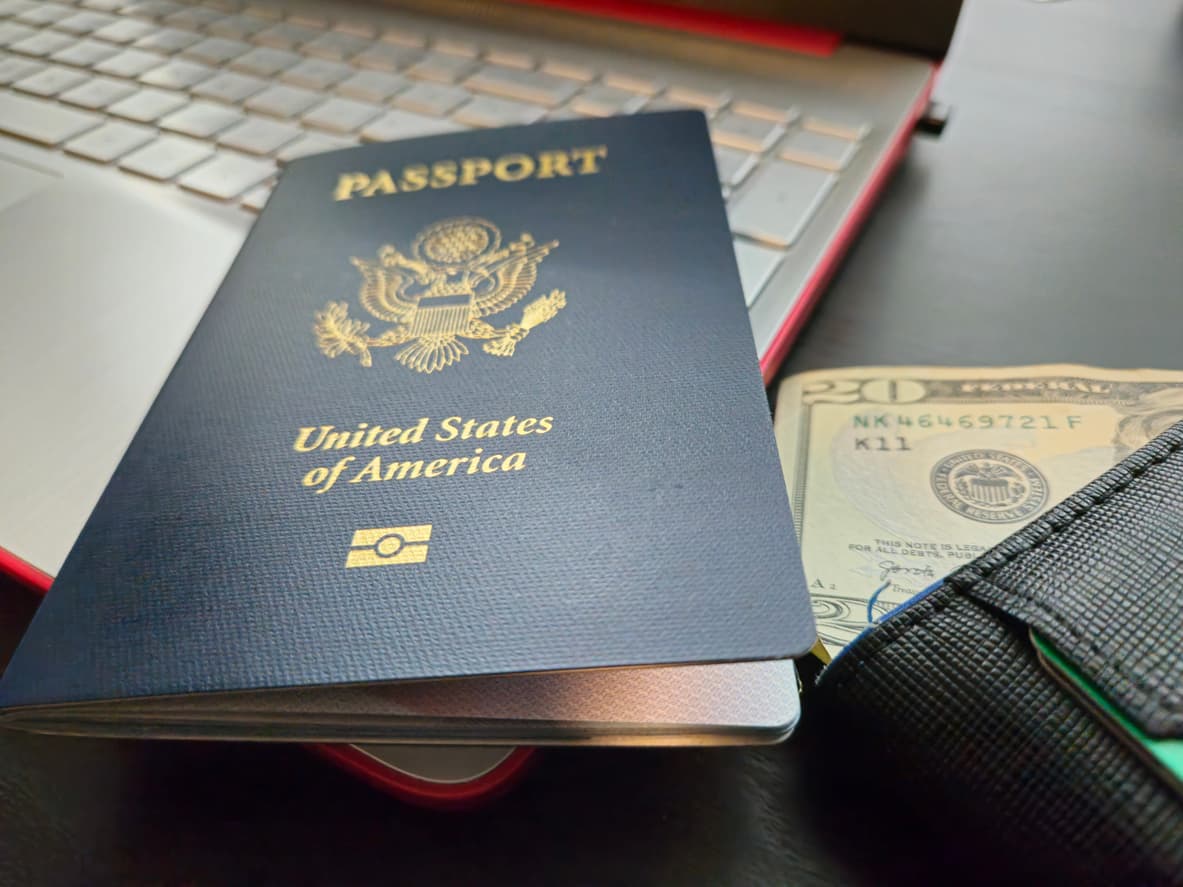
The State Department has proposed letting Americans abroad renew passports online, a change it estimates could cover approximately 220,000 overseas applications in fiscal 2027. State hasn't named the first countries or said when the rollout could begin.
The department also puts annual savings from Online Passport Renewal at $148.7 million. Nowhere in the rule does State total the savings from the overseas change alone. Only about $19 million in its table is calculated from the 220,000 overseas applications.
What the proposed rule would change
The existing Online Passport Renewal system requires applicants to be physically located in a US state or territory when they submit an application. Americans living abroad must follow the instructions of the embassy or consulate serving their location.
State wants to remove that geographic restriction. Eligible applicants could submit the application, photograph and payment through the department's website.
The department says online renewal would eliminate the traditional need for two visits to a consular post. Current procedures aren't uniform, however. The rule itself notes that some posts accept paper renewal applications, process or bundle them and send them to the United States.
Under the draft regulation, an applicant's previous passport would need to have been valid for 10 years and issued when the holder was at least 16. The application would have to arrive within 15 years of that passport's issue date, and the document would need to be available for electronic verification.
Current online rules go further. Domestic applicants must be at least 25, cannot change personal information and must have six weeks before international travel. Online renewals cannot be expedited.
State hasn't said which of those conditions would apply abroad.
The department considered accepting lost or stolen passports and extending the 15-year issuance limit to 18 years. It rejected both changes for now. State estimates the longer window would make another 495,000 applications eligible each year, but says its technology can't yet support them.
State would decide where the service opens
Online renewal wouldn't become available worldwide when the regulation takes effect. State plans to authorize countries individually and publish a running list on its passport website.
The rule gives no criteria for choosing them. An American in one country could receive access while an American across the border continues using a consulate.
State would also remove the requirement that a passport have no more than one year of validity remaining before an online renewal. The permitted renewal window would appear on the department's website instead, allowing State to change it without rewriting the regulation.
Getting the application online is only part of the process. The proposal doesn't explain how State would deliver new passports abroad or whether applicants could enter a foreign mailing address. Current online instructions refer only to addresses in the United States.
Cancellation presents another problem. State invalidates a domestic applicant's existing passport after the online application is submitted, and the proposed regulation requires an overseas applicant to have the current passport available for cancellation.
It doesn't say when that would happen overseas. For an American living abroad, going six weeks without a usable passport can be a bigger problem than making a consular appointment.
The 220,000 estimate counts applications
State projects 10,509,576 Form DS-82 renewal applications in fiscal 2027. It expects approximately 60% to pass through the online system, producing 6,279,511 online renewals.
Overseas applications could account for 220,000 of them.
A footnote traces that projection to 220,802 DS-82 applications handled through what State calls "OPDP and the Repatriation Program." The department then rounds the overseas estimate to approximately 220,000.
The number doesn't represent 220,000 distinct Americans. It counts applications, provides no country breakdown and assumes all eligible overseas applications would move online.
The volume is small beside State's overall passport workload. AER previously reported that more than 183 million valid US passports were in circulation, with a record 27.3 million issued in fiscal 2025.
Most of the $148.7 million is domestic
State's savings table contains five rows and mixes two applicant populations.
The department assigns $30,903,506 to passport photographs, based on 2,060,234 applicants paying approximately $15 each. That count represents 34% of a domestic pool of 6,059,511 applications.
State uses all 6,059,511 for the next two calculations: $72,411,156 in avoided postage and $26,358,873 in avoided travel to a mailing facility.
Those three domestic items total $129,673,535. The base is exactly State's projected 6,279,511 online applications minus the 220,000 overseas applications.
Some of that domestic benefit could come from relaxing the remaining-validity rule. State doesn't estimate how many additional domestic applicants that provision would bring into the system, so its incremental value can't be separated.
Only the lost-wage and consular-staff calculations use the 220,000 overseas applications. State puts them at $18,796,800 and $215,600, respectively.
The identifiable overseas portion totals $19,012,400. Calling $148.7 million the value of overseas online renewal would be wrong.
State assumes every applicant loses half a workday
State says it can't calculate how far Americans abroad travel to submit passport applications. Instead, it assumes every overseas applicant loses four hours of work to travel, traffic, security screening and the consular visit.
State says it derived the $44,439 annual wage from an Organization for Economic Cooperation and Development publication. It converts that to $21.36 an hour, or $85.44 for four hours.
Multiplying $85.44 by 220,000 produces nearly all the estimated overseas savings. The calculation doesn't include local transportation costs, international postage or differences among consular procedures.
The government saves 98 cents per application in the model. Across 220,000 renewals, reduced work for locally employed consular staff comes to $215,600.
The money and time savings
State expects online applications to move routine processing from overseas posts to the United States. It says consular employees could spend the recovered time on complex citizenship cases and special citizen services.
The proposal follows State's decision to close five overseas posts, though the department doesn't connect the actions. Four of those posts don't provide routine passport services.
Comments on docket DOS-2026-0925 remain open through Oct. 27. State could then adopt all, part or none of the proposal, with no deadline for a final decision.
The practical questions remain unanswered: where State would send the new passport and how long an applicant abroad would be left without a usable one. Until a final rule takes effect and State authorizes the applicant's country, online renewal still requires submitting the application from inside a US state or territory.