The EU Entry/Exit System exempts American residence permit holders across the 26 reporting European countries that run it, a group covering 370,573 permits valid on Dec. 31, 2025.
Two countries break the pattern. Americans holding Irish or Cypriot residence permits get registered in the system when they enter the Schengen Area, the European Commission said in a July 27 notice. That catches 14,078 people, or 3.7% of the American permit population in Europe.
First registration captures four fingerprints and a facial image. Later crossings verify against the stored file rather than collecting again. The system has logged more than 145 million entries and exits since it launched, the Commission said.
What the exemption attaches to
For residents, the exemption follows the document. Regulation (EU) 2017/2226 places holders of long-stay visas and residence permits outside the system's scope, and separately excludes nationals of Andorra, Monaco and San Marino and holders of Vatican City passports on grounds of nationality. Border checks stay conventional. Passport, permit, no biometric capture.
Two smaller categories matter for Americans specifically
The regulation also excludes third-country nationals exercising intra-EU mobility rights under the intra-corporate transferee directive and under Directive (EU) 2016/801, which covers researchers, students and trainees. An American researcher on a Belgian hosting agreement, working a mobility stint in France, stays outside the system when flying back into Paris from New York.
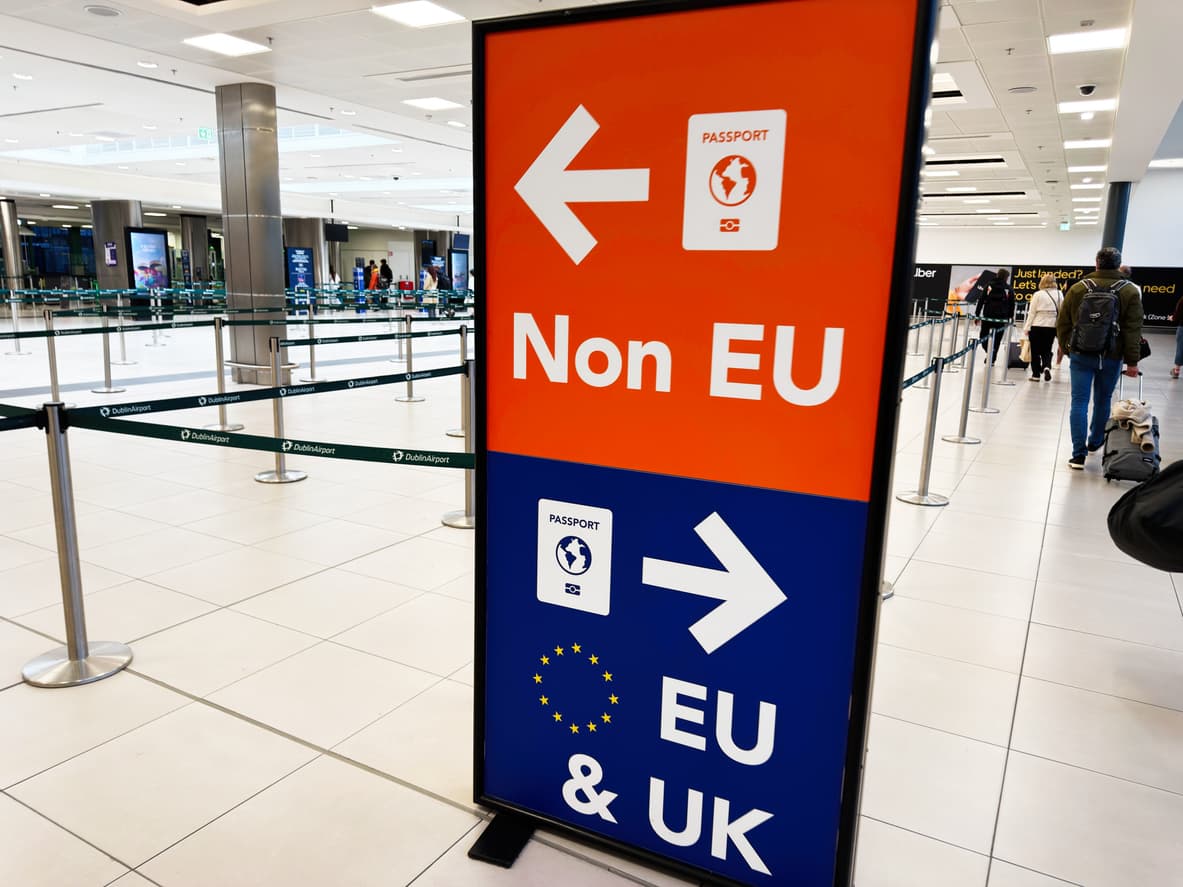
The regulation defines a residence permit by pointing to the Schengen Borders Code, which counts documents issued by states applying the Schengen acquis. Ireland sits outside the Schengen border acquis by treaty protocol. Cyprus hasn't been cleared to apply its border provisions. So an American with a Dublin work permit reaches a Schengen external border as a short-stay traveler, not as a resident the system already knows.
Germany holds the largest exempt group at 78,485 American permit holders in Eurostat's valid-permit count (a subset of the US-citizen population Germany's own register records, shown on the AER Germany page), followed by Spain at 59,088, where new permits to US citizens reached 15,638 in a single year. France follows at 43,948. Portugal, which grew faster than any large European destination between 2021 and 2024, slipped 4.4% in 2025 to 19,492.
Does the family-member card override the catch?
For some Americans, it does. Family members of an EU, Icelandic, Liechtenstein, Norwegian or Swiss citizen who hold a residence card under Directive 2004/38/EC fall outside the system regardless of which country issued it or whether they travel with the relative.
Family reasons account for 5,135 of Ireland's 12,828 American permit holders and 467 of Cyprus's 1,250. Those aren't counts of who benefits. Eurostat's family category folds free-movement cards together with ordinary reunification permits issued to spouses of Irish and Cypriot nationals, so the figures mark a ceiling rather than a total.
Cyprus has the fastest-growing American permit population in Europe
The two countries where the exemption fails sit at opposite ends of the growth table. Cyprus added 38.7% to its American permit stock in 2025, climbing from 901 to 1,250, the steepest one-year rise of any country with more than 500 American permit holders reporting to Eurostat. Ireland moved the other way, shedding 3.6% to fall from 13,306 to 12,828, after a period when US arrivals to Ireland nearly doubled.
Cyprus may not stay outside the exemption much longer
The college of commissioners adopted a positive assessment of the island's technical readiness July 14 and will put the "State of Schengen" report to the Council of the EU in September, commission spokesman Markus Lammert said. Readiness is not accession. That decision requires unanimity from the 25 EU members already inside the zone, and none of it has happened yet. Cyprus has marketed its 300,000 euro permanent residence route against that pending decision.
Ireland has no comparable path. Its opt-out is a treaty protocol rather than a readiness assessment, and it runs alongside the Common Travel Area with the United Kingdom.
The permit decides whose 90-day clock gets counted
The Commission set Oct. 12, 2025 as the start of a progressive rollout authorized by Regulation (EU) 2025/1534, which let member states phase in biometric registration over six months. Since April 10, the EES has replaced passport stamping at every external crossing point in the 29 countries operating it, which means the system calculates authorized short stays by itself.
That's the change for Americans on Irish and Cypriot permits. A weekend in Paris registers against a 90-days-in-180 allowance computed automatically, and overstay alerts generate without anyone noticing a date.
Americans holding permits from Germany, Spain, France or other countries operating the EES aren't registered at all when they cross an external Schengen border. The ceiling still applies to them. Their permits authorize residence in the issuing country, while time in other Schengen states stays capped at 90 days in any 180-day period under Article 21 of the Schengen implementing convention. EES simply doesn't count it for them, and it opens no entry-and-exit record.
The asymmetry runs both directions
Regulation 2017/2226 requires eu-LISA to host a web service where registered travelers can check their remaining authorized stay against an OK or NOT OK answer. Americans on Irish and Cypriot permits can use it. Americans on German or Spanish permits face the same ceiling elsewhere in Schengen with nothing automated to consult.
Denmark, Romania and Iceland filed no 2025 permit figures with Eurostat, which puts the real exempt total above 370,573.