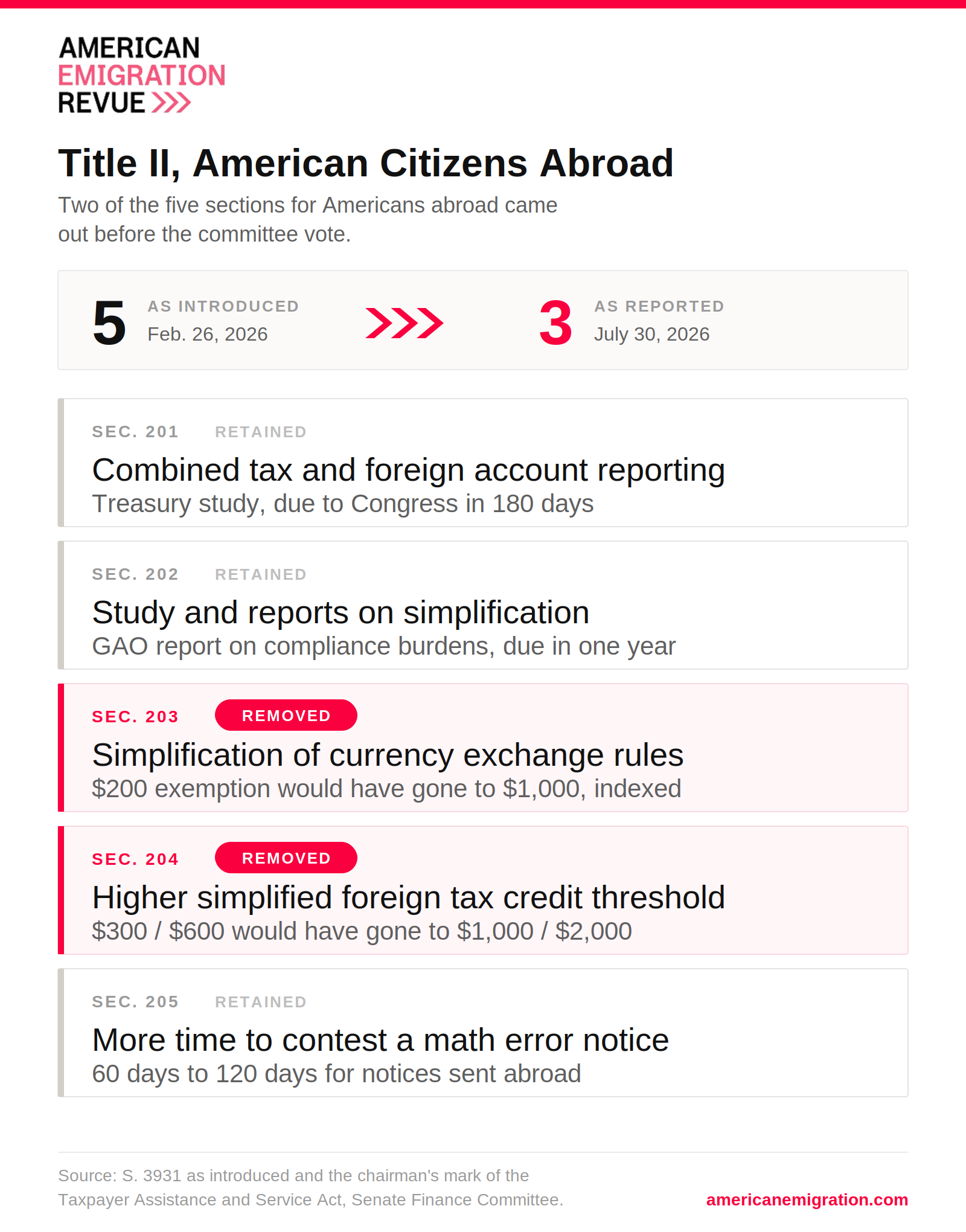
The Senate Finance Committee reported the Taxpayer Assistance and Service Act on July 30 with a title devoted to Americans living outside the United States. That title now runs three provisions. The bill Sen. Mike Crapo, R-Idaho, introduced on Feb. 26 carried five.
The two that came out were the only ones that would have changed how Americans abroad calculate what they owe.
What the committee kept and what it dropped
Title II of S. 3931 listed five sections. The chairman's mark released July 28 listed three.
Retained:
Section 201, report on combined tax and foreign bank and financial account reporting. Treasury would study how to merge international information reporting under the tax code and the Bank Secrecy Act, then report to Congress within 180 days of enactment.
Section 202, study and reports on simplification. The comptroller general would report publicly within one year on the compliance burdens carried by US citizens living abroad, and Treasury would answer within a year of that.
Section 205, extension of time to request abatement of math error. The window to contest a math error assessment would widen from 60 days to 120 when the notice goes to an address outside the United States.
Removed:
Section 203, simplification of currency exchanges rules. It would have raised the personal transaction exemption under section 988(e) from $200 to $1,000 and indexed it to inflation. It also would have amended section 165(c) to let filers deduct foreign currency losses tied to a mortgage on a residence abroad, and losses on the sale of that residence, against gain recognized the same year.
Section 204, increase in threshold for simplified foreign tax credit rules and reporting. It would have lifted the section 904(j) exemption from the foreign tax credit limitation from $300 to $1,000, and from $600 to $2,000 for joint filers, with inflation indexing.
The committee published no explanation for either removal.
Why the whole title scores $1 million
The Joint Committee on Taxation scored the mark as modified on July 29 as JCX-46-26. Title II comes to a revenue loss of $1 million across fiscal 2027 through 2036. Both study provisions score no revenue effect at all. The math error extension carries the entire figure.
Title I, tax administration and customer service, scores a loss of $500 million over the same 10 years. The bill nets out at a loss of $49 million.
What the dropped sections would have cost isn't on the record. JCT scored the mark, not the introduced bill, and congress.gov lists no cost estimate for S. 3931. Residence-based taxation, by contrast, has spent more than a year waiting on a revenue score before it can be reintroduced at all.
What the modification added outside the title
Crapo's modification, adopted at the markup, brought in the Fairness in Foreign Filing Act. It would create pre-assessment Appeals review for specified international information return penalties and repeal the off-Code reporting deadlines for foreign trusts and related persons. JCT scored it a negligible revenue effect.
That provision sits in Title XI, additional items, not in the American Citizens Abroad title. Filers abroad would get it either way. The committee reported the bill 26-1, with Sen. Elizabeth Warren, D-Mass., the only nay.
The reporting overlap GAO flagged in 2019
Americans abroad disclose the same accounts twice. The FBAR goes to the Financial Crimes Enforcement Network once foreign accounts pass $10,000 in aggregate value, due April 15 with an automatic extension to Oct. 15, and it isn't filed with the IRS at all. Form 8938 goes to the IRS under section 6038D at thresholds that start at $50,000 and shift with filing status and country of residence. The two cover different assets, and the penalties are steep. A non-willful failure to file an FBAR draws $10,000 per violation before inflation adjustments, a willful one the greater of $100,000 or half the account balance.
The comptroller general has already reported on this. GAO-19-180, published in April 2019, found close to 75% of US persons who reported foreign assets to the IRS also reported them separately to Treasury, and found foreign banks closing accounts held by US citizens rather than carry the compliance cost. It asked Congress to amend the tax code and the Bank Secrecy Act to align the requirements.
GAO still lists that request as open. Its February 2026 status note records no legislative action in the 119th Congress. Section 202 would order a fresh study of much the same ground.
What committee passage does and doesn't settle
Neither study has an established population to measure. No federal agency maintains a comprehensive count of US citizens living outside the United States.
The committee treated Americans abroad as a distinct class of taxpayer and gave them their own title in a bipartisan bill that cleared on a 26-1 vote. It also removed the two sections in that title that would have changed a number on a return.
The bill has not reached the Senate floor. A deficiency notice mailed abroad already allows 150 days against 90 at home. A math error notice allows 60 days either way, unless and until this becomes law.